20
Jul
The Room Was the Message
What Harvard’s greenest building taught me about private equity’s next act.
By Scott Podvin — Sustainable Investing Digest, in partnership with Skyline Property Experts
“Persistence is everything.”
David Rubenstein—co-founder of The Carlyle Group, one of the largest private investment firms in the world—has offered that advice to a generation of investors. Last week, I sat inside the building that bears his name and realized his three words describe more than a career strategy.
They describe how enduring value gets built. Slowly. Deliberately. Against consensus. Until one day the future is standing right in front of you—made of wood.
Let me explain.
A Private Equity Legend, Speaking Inside a Private Equity Legacy
Last week I returned to Cambridge and Boston for the Harvard Graduate School of Design’s Advanced Management Development Program Alumni Reunion, celebrating twenty-five years of the program and the retirement of Professor Richard Peiser, who built AMDP into one of the world’s premier executive programs for leaders of the built environment.
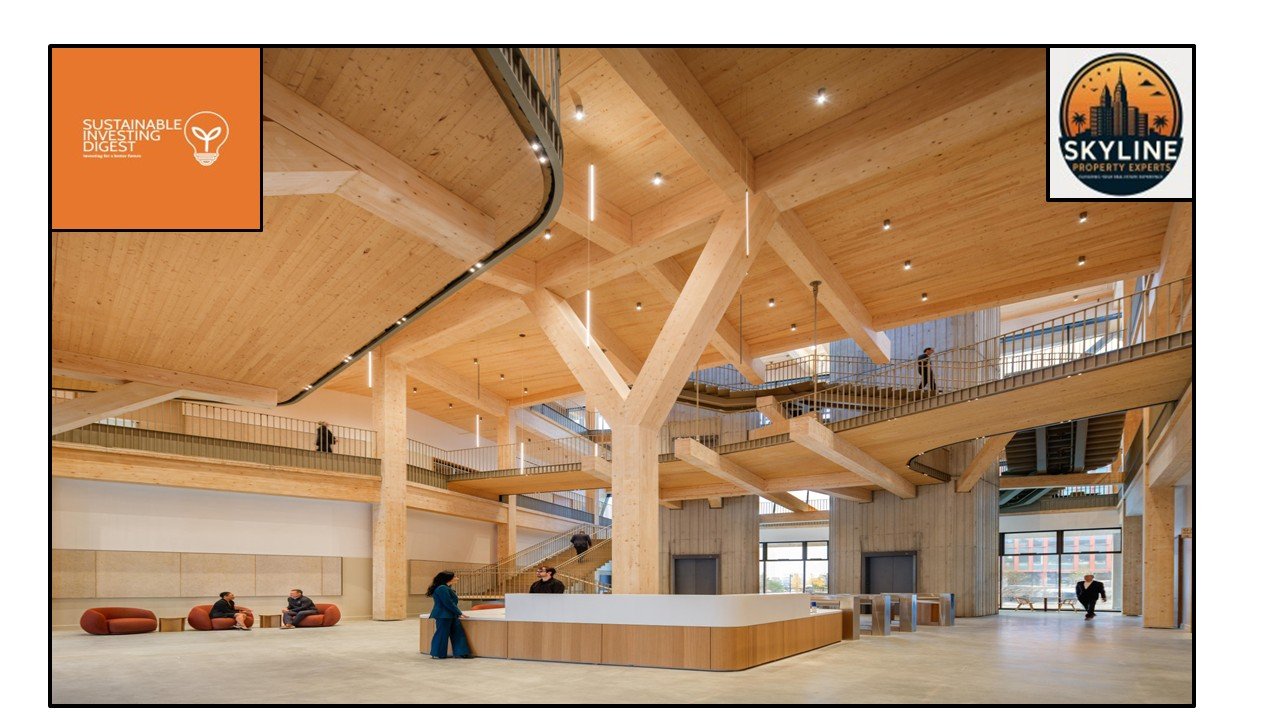
Our sessions convened at the David Rubenstein Treehouse on Harvard’s new Enterprise Research Campus in Allston—and the setting was no accident of scheduling. It was, for anyone paying attention, the entire thesis of this article rendered in timber and glass.
The Treehouse, designed by Studio Gang under Jeanne Gang—herself a GSD alumna and professor—is Harvard’s first mass timber building. According to Engineering News-Record, it is also the first building in Massachusetts to use low-carbon concrete at large scale. The 55,000-square-foot conference center features an Alaskan yellow cedar facade, bird-safe glass, rooftop solar, rainwater reuse, and a fossil-fuel-free, climate-resilient design targeting Living Building Challenge certification—among the most demanding building standards in the world.
And whose name is on it? David Rubenstein’s. A man who built his fortune in private equity chose to put his legacy into the most sustainable building on Harvard’s campus.
Sitting beneath those branching timber columns, I listened as Daniel M. Neidich—former Goldman Sachs partner, pioneer of the Whitehall Funds, and founder of Dune Real Estate Partners—delivered a presentation on private equity’s history and its future.
A private equity pioneer, speaking about the future of capital, inside a building funded by private equity wealth and constructed as a statement about the low-carbon future.
The room was the message.
And the message was integration. The room quietly connected disciplines that too often remain separate:
Architecture.
Capital.
Sustainability.
Innovation.
Public policy.
Leadership.
None dominated the conversation. Each depended upon the others. That may be the most important lesson of all—and it is the lesson the rest of this article unpacks.
Where Private Equity and Sustainability Converge
Here is what most investors still miss: the largest, most sophisticated capital in real estate is no longer treating sustainability as a compliance cost. It is treating sustainability as the opportunity itself.
Consider Daniel’s newest venture. In December 2024, Dune and TF Cornerstone launched Alta Residential, a $1 billion platform converting distressed office buildings into housing across major U.S. cities. The financial thesis is compelling on its own—over 18 million square feet of conversions are already underway in New York City alone, and Yardi estimates more than 1.2 billion square feet of U.S. office stock are quality conversion candidates.
But read the announcement closely and you’ll find the deeper logic: the partners emphasized that conversions revitalize downtowns while avoiding much of the embodied carbon that new construction generates. Reusing a structural frame that already exists is one of the most powerful decarbonization tools in real estate—and it happens to be where the returns are.
That is not sustainability as a marketing overlay. That is sustainability as investment strategy: the recognition that the built world’s biggest inefficiencies—empty towers, wasted carbon, undersupplied housing—are the same places where disciplined capital earns its keep.
This convergence of adaptive reuse, institutional capital, and sustainability reflects the strategic questions we evaluate every day at Skyline Property Experts. Whether the opportunity involves repositioning distressed assets, structuring joint ventures, healthcare campuses, hospitality, or institutional mixed-use development, the common denominator is never simply acquiring buildings. It is creating platforms capable of producing durable value across multiple market cycles.
Institutions, Not Buildings
Readers of my work know the sentence at the center of my philosophy: I don’t build projects—I build institutions.
Here is what I mean, as plainly as I can say it:
A building is a moment.
An institution is a commitment that compounds.
Across owners.
Across market cycles.
Across generations.
A building answers the question: what can this asset earn next year? An institution answers a harder question: what must be aligned—capital, governance, operations, design, leadership, community—so that this enterprise is still creating value when none of today’s owners are in the room? The first question produces transactions. The second produces platforms. Nearly everything that separates enduring investments from forgettable ones lives in the difference between those two questions.
I have watched this play out across my own career. In hospitality, institutional multifamily, healthcare, and life sciences alike, I’ve seen institutional thinking transform projects that initially appeared ordinary into assets capable of creating value for decades. The common thread was never simply superior architecture or better financing. It was aligning capital, operations, governance, and long-term purpose from the beginning—before the first drawing, before the first dollar.
The Rubenstein Treehouse passes that test. It is not merely 55,000 square feet of event space. It is a commitment: to a low-carbon future, to convening people across disciplines, to anchoring an entire innovation district. Its value will compound for decades in ways no pro forma fully captures.
The Invitation
Sustainable Investing Digest exists for one purpose: to explore where capital markets, sustainability, institutional investing, and the built environment intersect. If that intersection is where you work—or where you want to work—subscribe – here – https://www.linkedin.com/build-relation/newsletter-follow?entityUrn=7053058780464345088 — so the next edition finds you, and read the companion piece in my other publication, Global Empowerment Leadership, where I break down the full investment lessons of Daniel Neidich’s presentation. Then add your voice in the comments: where have you seen sustainability and returns reinforce each other—or collide?
And if you are weighing one of these questions in your own portfolio—an acquisition, a disposition, a repositioning, a joint venture—that is the daily work of Skyline Property Experts. Visit www.skylinepropertyexperts.com, call 786-676-4937, or email me directly at scott@skylinepropertyexperts.com.
Closing the Circle
My deep thanks to Professor Richard Peiser for inviting Daniel Neidich to address our alumni community—a fitting collaboration between two Yale men whose friendship spans decades—and to Daniel for sharing fifty years of hard-won wisdom with the Harvard GSD AMDP community.
Looking back, I realized the Treehouse wasn’t simply where our reunion happened.
It was the reunion.
It embodied exactly what Professor Peiser spent twenty-five years teaching us: that great projects endure because they integrate design, finance, leadership, sustainability, and community into something larger than themselves.
Persistence is everything. Rick persisted for twenty-five years, and built an institution. So can we.
#SustainableInvesting #ESG #MassTimber #GreenBuilding #Decarbonization #ImpactInvesting #RealEstateDevelopment #PrivateCapital #ClimateFinance #BuiltEnvironment #HarvardAlumni #SustainableInvestingDigest