17
Aug
The Best Adaptive Reuse Strategy Depends on the ZIP Code
Why sophisticated investors study markets before they study buildings.
“Persistence is everything.”
— David Rubenstein
Persistence is one of the defining characteristics of successful investors.
Markets move.
Interest rates rise.
Cycles change.
Projects stall.
Capital waits.
But persistence alone has never been an investment strategy.
The investors who consistently outperform are persistent in questioning assumptions that everyone else has accepted as fact.
That realization stayed with me after returning from Harvard University’s Advanced Management Development Program Reunion.
One conversation in particular challenged the way many investors think about adaptive reuse.
Not because it offered a new answer.
Because it asked a better question.
Most Investors Start With the Wrong Question
Daniel Neidich, CEO of Dune Real Estate Partners, described how institutional investors are deploying billions of dollars to reposition obsolete office buildings into residential communities.
Most headlines stopped there.
Office becomes apartments.
Simple.
Except it isn’t.
Listening to that discussion, I realized most of us instinctively ask:
What can this building become?
Institutional investors often begin somewhere entirely different.
What does this market need?
That subtle distinction changes the entire investment thesis.
Buildings Don’t Create Value. Markets Do.
After returning from Harvard, our team at Skyline Property Experts decided to test that question.
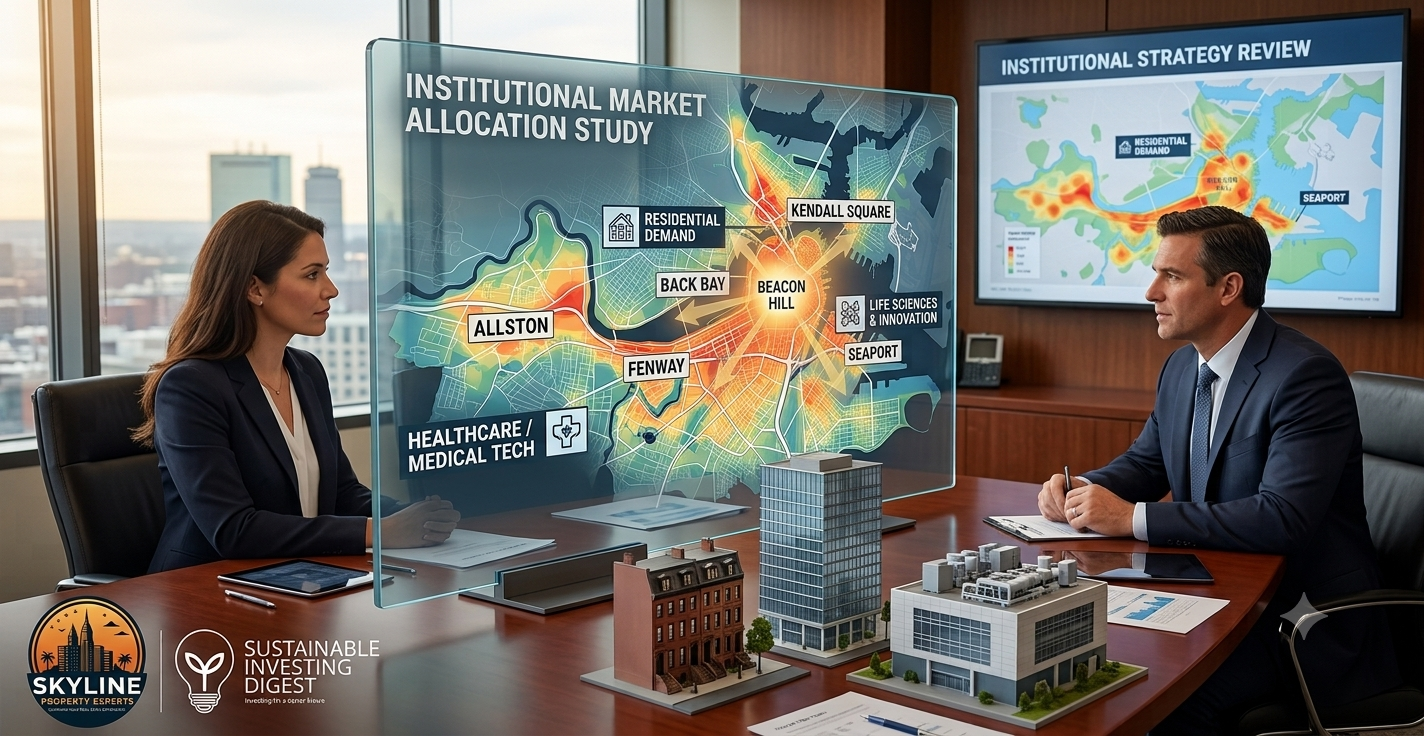
We examined adaptive reuse opportunities across Boston’s Back Bay and Beacon Hill—two of the country’s most prestigious urban neighborhoods.
At first glance the conclusion appeared obvious.
Office vacancies.
Housing shortages.
Convert offices into apartments.
Problem solved.
Instead, the research produced a much more interesting lesson.
Adaptive reuse isn’t really about buildings.
It’s about markets.
Three Markets. Three Completely Different Investments.
One of the biggest misconceptions in commercial real estate is that successful adaptive reuse follows a repeatable formula.
It doesn’t.
The same square footage.
The same construction era.
The same vacancy rate.
Can produce entirely different investment decisions.
In Back Bay, obsolete office buildings often become attractive residential conversion candidates because historic floorplates, premium rental demand, public incentives, and long-term tax abatements align.
Move only a few miles away and that thesis begins to fall apart.
Not because demand changes.
Because the market changes.
Sometimes Physics Wins.
Boston is one of the world’s premier life sciences ecosystems.
Logic might suggest converting older office buildings into biotechnology laboratories.
Our research suggests otherwise.
Historic preservation requirements restrict mechanical systems.
Ceiling heights cannot accommodate laboratory infrastructure.
Structural loading cannot economically support specialized scientific equipment.
Mechanical ventilation requirements exceed what many historic buildings can physically provide.
Demand doesn’t overcome physics.
Markets don’t eliminate engineering.
Sophisticated investors understand the difference.
Location Is an Investment Thesis
Travel a short distance toward Kendall Square, the Seaport District, Allston, or Fenway and the economics reverse.
Now the surrounding ecosystem changes.
Research universities.
Biotechnology companies.
Venture capital.
Hospitals.
Talent.
Infrastructure.
Suddenly laboratory conversions become logical.
The building did not become more valuable.
The ecosystem did.
Institutional capital wasn’t chasing real estate.
It was following innovation.
Healthcare Is Quietly Following the Same Playbook
The same pattern is emerging across healthcare.
Former hospital campuses are becoming innovation districts.
Administrative buildings are evolving into translational research facilities.
Outpatient care increasingly replaces inpatient expansion.
Technology transfer, biotechnology partnerships, ambulatory surgery centers, and advanced therapeutics are becoming integral components of modern healthcare campuses.
The objective isn’t simply to modernize real estate.
It’s to redesign the economics of healthcare delivery.
Once again…
The investment isn’t the building.
The investment is the market the building serves.
The Real Lesson
Real estate professionals often say,
“Location, location, location.”
Institutional investors take that idea one step further.
They ask:
Which location?
Why this location?
Why now?
Adaptive reuse is not a construction strategy.
It is a capital allocation strategy.
Successful investors don’t simply recycle buildings.
They recycle economic potential.
Looking Beyond Headlines
Headlines tell us that office buildings are obsolete.
Institutional investors ask which office buildings.
Headlines tell us adaptive reuse is the future.
Institutional investors ask adaptive reuse into what?
Headlines tell us life sciences are booming.
Institutional investors ask where?
The answers are rarely universal.
They are almost always local.
That’s why adaptive reuse may be one of the most location-sensitive investment strategies in commercial real estate today.
Conclusion
David Rubenstein reminded us that persistence matters.
I would add one observation.
Persistence without curiosity eventually becomes routine.
The investors who consistently outperform are not merely persistent.
They are relentlessly curious.
They challenge assumptions.
They test markets.
They underwrite ecosystems.
Most importantly…
They understand that buildings may capture our attention—
but markets determine value.
Continue the Conversation
Every market tells a different investment story.
The mission of Sustainable Investing Digest is to examine how institutional investors identify those stories before they become obvious—through disciplined research, market analysis, and long-term strategic thinking.
If you enjoy thoughtful discussions about capital allocation, adaptive reuse, healthcare real estate, infrastructure, sustainability, and institutional investing, I invite you to subscribe.
Subscribe here: https://www.linkedin.com/build-relation/newsletter-follow?entityUrn=7053058780464345088
Discussion Question
If you were allocating capital today, which adaptive reuse strategy offers the strongest long-term opportunity?
-
Residential conversions
-
Healthcare campuses
-
Life sciences
-
Hospitality
-
Industrial
-
Something else?
I’d enjoy hearing your perspective.
Skyline Research Note
The market observations discussed in this article are informed by independent research conducted by Skyline Property Experts, examining adaptive reuse strategies and institutional investment dynamics across the Greater Boston market.
#InstitutionalInvesting #AdaptiveReuse #CommercialRealEstate #CapitalAllocation #PrivateEquity #RealEstateDevelopment #LifeSciences #HealthcareRealEstate #UrbanDevelopment #SustainableInvesting #Leadership #Strategy #ExecutiveEducation