17
Aug
The Factory Is the Strategy
Why Reshoring Is Becoming a Sustainable-Investing Thesis
“The future depends on what you do today.”
That idea has always applied to capital allocation.
But in 2026, it applies with unusual force to manufacturing.
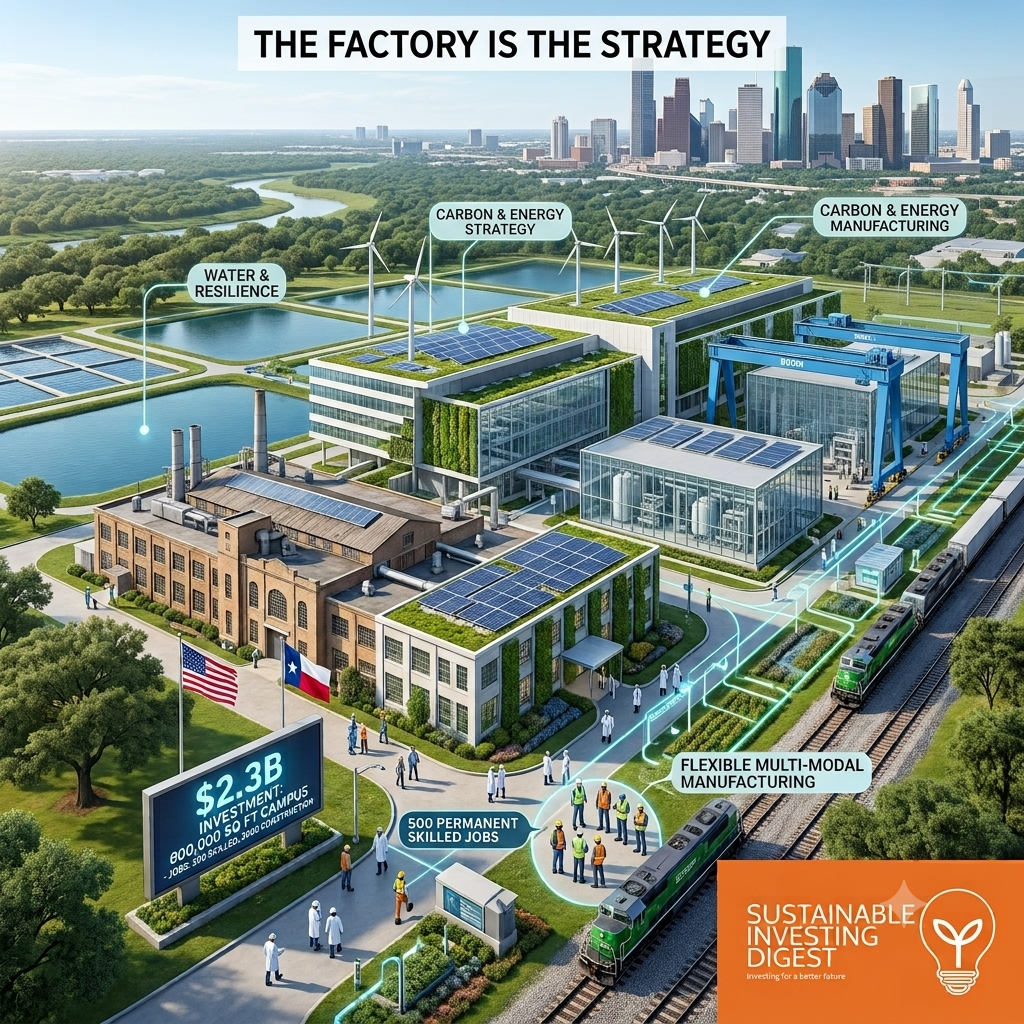
Bristol Myers Squibb’s newly announced $2.3 billion investment in a 600,000-square-foot manufacturing campus at Generation Park in Houston is more than a pharmaceutical expansion. It is a long-duration vote on geography, infrastructure, labor, energy, supply-chain security and the future of U.S. industrial capacity. The facility is expected to manufacture small-molecule medicines, biologics and antibody-drug conjugates, while retaining flexibility to expand or reconfigure as pipeline needs evolve. It is projected to create nearly 500 permanent skilled jobs and approximately 2,000 construction-related jobs between 2027 and 2030. The project is part of BMS’s broader $40 billion U.S. investment commitment.
Texas is supporting the project with a $4.89 million Texas Enterprise Fund grant and additional incentives through the state’s Jobs, Energy, Technology and Innovation program. That makes the investment not merely a corporate real-estate decision, but a public-private infrastructure decision as well.
For sustainable investors, that distinction matters.
Because sustainability is no longer only about how efficiently a building consumes energy after it opens.
Increasingly, it is about whether the entire operating system surrounding the asset can remain productive when assumptions change.
And that may be one of the defining investment questions of the next decade.
Sustainability’s Definition Is Getting Bigger
For years, sustainable real-estate investing concentrated heavily on the physical asset.
-
Energy use.
-
Embodied carbon.
-
Water.
-
Building materials.
-
Certifications.
Those remain important.
But a highly efficient building can still sit inside a fragile business system.
A factory may achieve extraordinary environmental performance and still depend upon vulnerable supply routes, constrained utilities, concentrated suppliers, geopolitical chokepoints or a workforce that cannot be replaced.
Conversely, domestic production is not inherently sustainable merely because it is domestic.
A poorly located manufacturing campus consuming enormous quantities of power and water while locking an owner into an inflexible production configuration may simply exchange one form of risk for another.
The relevant question therefore becomes broader:
How durable is the enterprise value supported by the asset?
That requires investors to evaluate not merely the environmental footprint of the facility, but the resilience of the system it serves.
Harvard Business School and the Harvard Graduate School of Design increasingly frame real-estate decision-making in similarly integrated terms: sustainability, financing, design, technology, resilience and asset value are not separate disciplines. They interact.
That is exactly what manufacturing capital is now forcing investors to recognize.
Supply-Chain Resilience Has an Economic Value
For much of the globalization era, the optimization equation was straightforward:
Find the lowest-cost producer.
That model delivered tremendous efficiency.
It also created concentration.
The OECD now cautions that simply moving all production back inside national borders would not necessarily improve resilience; diversification, flexibility and risk management matter more than indiscriminate localization.
That distinction is important.
Reshoring should not mean retreating from global markets.
It should mean pricing risk more intelligently.
Consider the variables that increasingly belong in the investment model:
-
geopolitical exposure;
-
shipping disruption;
-
tariffs;
-
concentration of critical suppliers;
-
intellectual-property security;
-
inventory requirements;
-
time-to-market;
-
regulatory risk;
-
redundancy;
-
transportation costs;
-
supply interruption.
The cheapest manufacturing location in a spreadsheet may therefore not represent the lowest-cost manufacturing system.
The International Energy Agency is making much the same point in the energy sector. Its 2026 work on technology supply chains concludes that geographic concentration creates genuine vulnerability and that industrial competitiveness depends on far more than wages: infrastructure quality, energy costs, skilled labor, manufacturing efficiency, digitalization and innovation ecosystems all matter.
Those principles extend well beyond energy technology.
They belong in life sciences.
Semiconductors.
Data centers.
Advanced materials.
Defense.
Food systems.
And virtually every sector where operational interruption can destroy value faster than marginal production savings can create it.
In Advanced Manufacturing, Location Is an Operating System
Real-estate professionals sometimes speak about industrial development as if location means:
-
land,
-
access, and,
-
zoning.
That definition is becoming obsolete.
For sophisticated manufacturing, location increasingly means:
power + water + wastewater + transportation + digital infrastructure + workforce + permitting + redundancy + expansion capacity.
In other words:
In advanced manufacturing, location is not an address. It is an operating system.
That operating system can create or destroy enterprise value.
A site with inexpensive land but insufficient electrical capacity may be more expensive than a premium location with reliable power.
A jurisdiction offering generous tax incentives but lacking specialized workers may produce higher long-term labor costs.
A building optimized for one manufacturing process may become a stranded asset when the underlying technology changes.
The World Economic Forum’s work on advanced manufacturing increasingly treats productivity, resilience, sustainability, technology and talent as mutually reinforcing rather than competing objectives. Its Global Lighthouse Network now encompasses hundreds of factories applying advanced technologies to improve productivity, supply-chain resilience, sustainability and workforce performance simultaneously.
That is the direction institutional underwriting needs to follow.
The Sustainability Paradox of Reshoring
There is an uncomfortable truth that sustainable investors should confront directly:
Reshoring can increase resource intensity.
New industrial campuses consume land.
Large manufacturing facilities consume energy.
Many manufacturing processes require substantial water.
Utilities may need to construct additional capacity.
Transportation patterns may change.
New infrastructure creates embodied carbon.
So it is intellectually lazy to describe every domestic manufacturing investment as sustainable simply because it improves supply security.
The more useful question is:
Does the complete lifecycle of the investment improve resilience and enterprise value enough to justify its environmental and capital requirements?
That requires a much richer underwriting framework.
An investor should ask:
What powers the facility?
How resilient is that power supply?
How exposed is the operation to water stress?
Can reclaimed water be used?
How much additional infrastructure must be constructed?
Can production waste be reused or reduced?
How much transportation risk disappears?
What is the cost of disruption under the existing supply chain?
And perhaps most importantly:
How adaptable is the asset when today’s manufacturing assumptions become obsolete?
That final question may be where the greatest sustainable value resides.
Optionality May Be the Most Valuable Green Feature
The BMS announcement contains a detail that investors should not overlook.
The Houston facility is being designed as a flexible, multi-modal manufacturing platform capable of supporting multiple types of pharmaceutical production and adapting as BMS’s pipeline changes.
That is not merely an operating feature.
It is an investment feature.
A rigid facility has fewer futures.
A flexible facility has more.
And every future configuration that remains technically and economically feasible represents preserved optionality.
That matters because the environmental cost of obsolescence can be enormous.
Demolition.
Replacement.
New embodied carbon.
New infrastructure.
Lost operating time.
Additional capital expenditure.
Workforce displacement.
The sustainable asset may therefore not be the building with the lowest carbon footprint on opening day.
It may be:
the asset that requires the least destruction, reinvestment and displacement when tomorrow’s operating model arrives.
That reframes sustainability from an environmental score into something closer to a real-option value.
The investor begins asking:
How many future decisions remain available?
Can the facility support another product?
Can it expand?
Can portions be repurposed?
Can new technology be integrated?
Can infrastructure capacity grow?
Can ownership or occupancy structures change?
Those are sustainability questions because they are durability questions.
And they are investment questions because durability has economic value.
Capital Is Voting With Its Feet
BMS is hardly alone.
Across pharmaceuticals and advanced manufacturing, corporations are reconsidering where long-lived capital should reside.
The policy environment matters. So do tariffs and incentives.
But reducing the trend to politics misses the deeper shift.
Companies increasingly have to price resilience.
The IEA notes that industrial competitiveness increasingly depends on secure energy systems, infrastructure, skilled labor, digitalization and innovation ecosystems.
The World Economic Forum describes a manufacturing paradigm in which sustainability, intelligence and resilience increasingly reinforce one another.
Harvard Business School recently highlighted the same tension in India’s solar manufacturing strategy: imported equipment could remain cheaper, while domestic production offered greater supply-chain independence and resilience.
That is exactly the trade-off investors need to understand.
Not:
domestic versus foreign.
But:
efficiency versus resilience versus optionality versus capital intensity.
The highest-value solution may involve some domestic manufacturing, some diversified international sourcing, inventory buffers, strategic partnerships and multiple supply channels.
Sustainable investing is increasingly about optimizing that entire system.
Public Incentives Are Part of the Infrastructure Capital Stack
Large advanced-manufacturing projects also force a reconsideration of public incentives.
Too often, incentives are discussed simply as:
taxpayer subsidy versus corporate benefit.
The reality can be more sophisticated.
A major manufacturing campus may require:
corporate equity,
development capital,
utility upgrades,
roads,
workforce training,
tax incentives,
district infrastructure,
state grants,
local approvals.
The public and private sectors are effectively assembling an infrastructure capital stack.
The analytical question for taxpayers and investors alike should therefore be:
Does the public contribution create durable economic capacity that outlasts the incentive itself?
BMS’s Houston project is expected to create hundreds of skilled permanent positions alongside thousands of construction-related jobs and add another major life-sciences manufacturing platform to a region already attracting substantial pharmaceutical investment.
That does not automatically make the incentive economically justified.
But it gives investors a much richer framework for evaluating what the public capital is purchasing:
workforce,
infrastructure,
industrial clustering,
tax base,
supply-chain capacity,
and strategic resilience.
The Sustainable Investor’s New Manufacturing Scorecard
If reshoring is becoming an investment thesis, sustainable investors need something more rigorous than slogans.
I would begin with six questions.
1. Resilience What critical operating risks does the location reduce—and what new risks does it create?
2. Infrastructure Can power, water, transportation, wastewater and digital systems reliably support the intended operation?
3. Human Capital Can the market recruit, train and retain the specialized workforce required for decades rather than merely for construction?
4. Environmental Load What are the lifecycle implications for energy, water, emissions, waste and transportation?
5. Strategic Optionality How many economically feasible future operating configurations will the asset preserve?
6. Enterprise Economics Does the incremental capital required for resilience produce an acceptable risk-adjusted return?
That final question keeps sustainable investing grounded where it belongs:
in investment discipline.
Because resilience purchased at any price is not resilience.
It is overcapitalization.
The Factory Is the Strategy
For the last generation, sustainable investing frequently began with a question like:
How efficiently does this asset operate?
The next generation may begin somewhere else:
How resilient is the operating system this asset supports?
That difference is profound.
A factory is not sustainable simply because it is located in America.
A building is not sustainable simply because it holds a certification.
And an investment is not sustainable because someone attached an ESG label to it.
Sustainable enterprise value is created when capital is deployed into assets and operating systems capable of surviving disruption, adapting to change and remaining economically productive long after today’s assumptions expire.
That is why BMS’s $2.3 billion Houston investment deserves attention well beyond the pharmaceutical industry.
It is part of a larger shift in how companies are thinking about capital, geography and resilience.
The factory is no longer simply where the strategy happens.
The factory is becoming the strategy.
And perhaps the more useful version of the thought we began with is this:
The future of enterprise value depends on the choices capital makes today.
At Skyline Property Experts and Capital Advisors USA, we help investors and operating companies evaluate real estate not simply as occupancy, but as capital allocation, operating infrastructure and strategic optionality. Whether the question is acquisition, disposition, expansion, redevelopment, recapitalization or repositioning, the highest-value decision is often the one made before capital becomes irreversible.
If you’re evaluating a complex real-estate or operating-platform decision, let’s compare the alternatives before the future gets expensive.
And if this perspective resonates, subscribe to Sustainable Investing Digest for continuing analysis at the intersection of capital, real estate, infrastructure, sustainability and long-term enterprise value.
SUBSCRIBE TO SUSTAINABLE INVESTING DIGEST by clicking this link: Subscribe on LinkedIn https://www.linkedin.com/build-relation/newsletter-follow?entityUrn=7053058780464345088
Because the most consequential investment decisions are rarely about what an asset is today.
They are about what it can still become tomorrow.
#SustainableInvesting #Reshoring #AdvancedManufacturing #SupplyChainResilience #LifeSciences #Infrastructure #CapitalAllocation