17
Aug
Stop Building Alone
“Alone we can do so little; together we can do so much.” — Helen Keller
The next great development opportunity may not be another building, clinic, investment fund, or joint venture.
It may be the platform that connects them.
Commercial real estate has traditionally operated as a pipeline: acquire land, secure capital, construct an asset, lease the space, stabilize the property, and eventually sell or refinance it.
Healthcare has followed a similar sequence: recruit physicians, open facilities, negotiate hospital and payer contracts, serve patients, and add locations as demand grows.
Each participant generally performs its own part of the process.
But the biggest opportunities are increasingly appearing between those parts.
Developers need operators. Healthcare providers need strategically located facilities. Investors need credible sponsors and measurable demand. Physicians need administrative infrastructure. Patients need coordinated access. Municipalities need economic development. Technology companies need physical locations in which their solutions can be deployed.
A platform does not merely own every component. It creates the standards, relationships, data, governance, and shared infrastructure that allow those participants to create more value together than they could independently.
That is why the future may belong not merely to the organizations that build the most—but to those that connect the best.
From pipeline to platform
Harvard Business Review distinguishes traditional pipeline businesses from platforms that create value by facilitating interactions among outside participants. In a pipeline, competitive advantage comes largely from controlling resources and optimizing an internal value chain. In a platform, the critical asset is the network itself: its participants, shared rules, trusted information, and the increasing value created as more capable participants join.
The shift is already reshaping the largest companies in the world. Harvard researchers reported in 2025 that seven of the world’s ten most valuable companies had launched platform businesses, as had more than 60% of unicorn startups. Their research also found that companies frequently miss platform growth because they assume they must own every interaction, fail to invite outside organizations that can contribute value, or never establish a compelling theme broad enough to unite the ecosystem.
The lesson is not that every company should become a technology marketplace.
The lesson is simpler:
Ownership is not the only path to control, and control is not the only path to value.
A developer may not need to employ physicians. A healthcare organization may not need to become a real estate developer. An investor may not need to manage every operating function.
They do, however, need an operating architecture that aligns incentives, defines responsibilities, protects trust, measures results, and makes collaboration repeatable.
Case study: Beike built the operating system, not merely the brokerage
China’s Beike platform grew from the Lianjia real estate brokerage into an integrated housing-services ecosystem.
Rather than limiting itself to representing buyers and sellers, Beike developed an Agent Cooperation Network that established common listing standards, allocated roles among participating agents, divided commissions, verified property information, and enabled cooperation across competing brokerage brands. The company then added transaction support, escrow, SaaS tools, training, renovation, leasing, rental management, and other housing-related services.
By the end of 2025, the platform included more than 445,000 active agents, approximately 58,000 active brokerage stores, and 279 brokerage brands. During the year, it facilitated approximately 5.6 million housing transactions with aggregate gross transaction value of approximately $455.2 billion. About 68% of the gross transaction value from existing- and new-home transactions came through connected brokerage stores and other externally connected sales channels rather than Beike’s original brokerage alone.
The most important innovation was not simply a website carrying property listings.
It was the creation of an operating system through which previously fragmented participants could exchange trusted information, divide responsibilities, complete transactions, and earn revenue together.
That model has direct implications for commercial real estate.
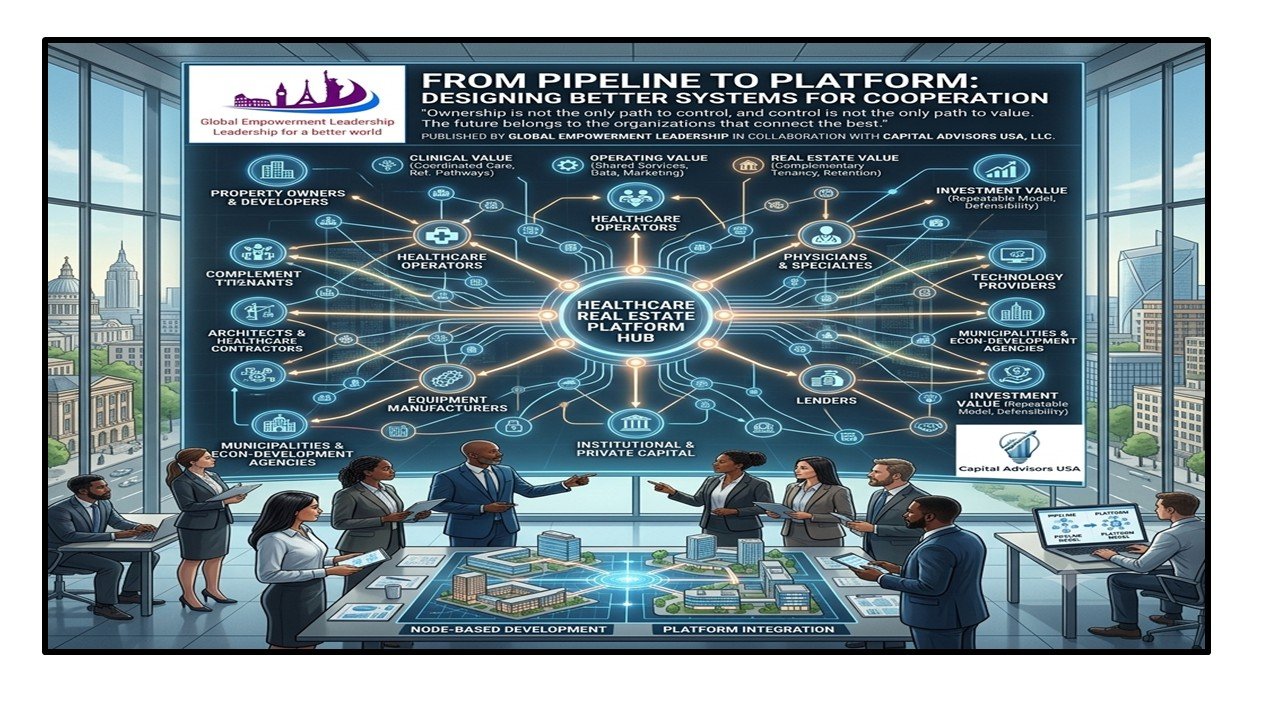
Imagine a development platform connecting:
- property owners and developers;
- healthcare operators;
- physicians and specialty practices;
- architects and healthcare contractors;
- institutional and private capital;
- equipment manufacturers;
- technology providers;
- lenders;
- municipalities and economic-development agencies; and
- complementary tenants.
The platform’s value would not come from owning every participant. It would come from reducing the friction, uncertainty, duplication, and execution risk that prevent those participants from working together effectively.
Case study: Mayo Clinic is extending healthcare beyond its walls
Mayo Clinic has explicitly described its strategy as moving healthcare from a pipeline model to a platform model.
Its platform connects clinicians, health systems, researchers, innovators, and technology developers through secure access to curated and de-identified clinical data. Mayo Clinic’s distributed model allows participating organizations to retain control of their data while approved analyses can be performed across a broader and more diverse clinical network.
By 2025, the platform’s network encompassed approximately 26 petabytes of clinical information, including more than 3 billion laboratory tests, 1.6 billion clinical notes, and more than 6 billion medical images. Mayo also operates a care network involving 50 organizations, 83 hospitals, 20,000 physicians, 26,000 staffed hospital beds, and approximately 18.8 million patient lives.
Mayo’s experience illustrates an important point for healthcare developers and investors:
A physical facility can be valuable, but the real enterprise value may come from the network operating through it.
A regional clinical hub could combine physician offices, diagnostics, imaging, infusion, pharmacy, rehabilitation, research, telemedicine, data infrastructure, and complementary specialties. Yet the building becomes truly strategic only when those functions are linked by shared referral pathways, operating standards, information systems, quality metrics, and financial incentives.
The facility is the node.
The platform is the system.
The platform opportunity in healthcare real estate
For developers, the platform question is not simply:
What can we build here?
It is:
Which participants must be connected for this development to become more valuable over time?
For healthcare organizations, the question is not merely:
How much space do we need?
It is:
Which clinical services, referral sources, physicians, technologies, and complementary partners should operate within the same regional ecosystem?
For investors, the question is not only:
What is the projected return on this asset?
It is:
Does the platform create repeatable demand, lower customer-acquisition costs, improve tenant retention, diversify revenue, strengthen operating margins, and produce a model that can be replicated in other markets?
A well-designed healthcare real estate platform can create several distinct sources of value:
Clinical value: coordinated care, stronger referrals, better patient access, improved physician collaboration, and expanded service offerings.
Operating value: shared administrative services, procurement, technology, scheduling, billing, data, marketing, and support infrastructure.
Real estate value: more durable occupancy, complementary tenancy, lower effective occupancy costs, better space utilization, and more credible development underwriting.
Investment value: multiple revenue streams, greater scalability, stronger market defensibility, and the possibility of repeating the operating model across additional acquisitions or developments.
Platforms still require discipline
Platforms are not automatically successful simply because they connect multiple parties.
The classic HBR research on two-sided markets emphasizes that platforms must decide which participants to attract first, which side should be subsidized, how pricing will work, how quality will be governed, and how the platform will respond when another network attempts to absorb or bypass it.
The recent history of GoHealth provides a useful caution. Harvard Business School’s 2026 case examines the company as a rapidly growing Medicare-focused health-insurance intermediary approaching a major public offering, but also highlights complex governance, related-party, ownership, and board-accountability questions.
In June 2026, GoHealth entered a prepackaged Chapter 11 restructuring supported by its lenders and major stakeholders. The company continued operating, but the restructuring demonstrates that rapid platform growth cannot substitute for sound governance, sustainable unit economics, capital discipline, and properly aligned stakeholder interests.
That may be the most important lesson of all.
A platform is not merely a collection of partners.
It requires:
- a clear value proposition;
- transparent participation rules;
- credible governance;
- reliable data;
- appropriate quality controls;
- aligned economics;
- measurable performance;
- and an accountable platform leader.
Without those elements, an ecosystem becomes a collection of disconnected relationships.
With them, it can become an engine for growth.
Start with one shared problem
The best platforms rarely begin by trying to solve everything.
They begin with a painful, recurring problem that no participant can solve efficiently alone.
In healthcare real estate, that problem might be:
- locating the right regional clinical hub;
- consolidating fragmented practices;
- matching underused facilities with growing operators;
- integrating complementary specialties;
- financing adaptive reuse;
- coordinating hospital, physician, and outpatient networks;
- connecting developers with qualified healthcare tenants; or
- creating a repeatable post-acquisition integration model for private equity.
Solve one problem well.
Establish trusted rules.
Measure the results.
Then invite additional participants and services that make the platform more useful to everyone already within it.
That is how a project becomes a program.
That is how a program becomes a platform.
And that is how a platform becomes an enduring source of enterprise value.
The call to action
Helen Keller reminded us that “alone we can do so little; together we can do so much.”
The opportunity before developers, healthcare leaders, investors, physicians, and advisers is not merely to cooperate more often. It is to design better systems for cooperation—systems that transform isolated capabilities into shared growth.
Where have you seen a development, healthcare venture, investment partnership, or joint venture become more valuable because the right parties were connected?
What prevented the collaboration from happening sooner?
Please share your experience in the comments and forward this article to a developer, healthcare executive, investor, or operating partner who may be thinking about the same challenge.
Subscribe to Global Empowerment Leadership for future discussions on real estate, healthcare, private equity, leadership, and platform value creation by clicking this link: https://www.linkedin.com/build-relation/newsletter-follow?entityUrn=7060440518475804672
Capital Advisors USA, LLC is also offering complimentary introductory consultations for organizations evaluating a development project, healthcare platform, strategic joint venture, adaptive-reuse opportunity, or investment partnership. The first conversation may reveal that the greatest opportunity is not another asset built alone—but a platform built together.
Published by Global Empowerment Leadership in collaboration with Capital Advisors USA, LLC.
References
Bryce, D. J., Dyer, J., & Van Alstyne, M. W. (2025). Are You Missing Growth Opportunities for Your Platform? Harvard Business Review, May–June 2025, Product No. R2503E.
Eisenmann, T. R., Parker, G. G., & Van Alstyne, M. W. (2006). Strategies for Two-Sided Markets. Harvard Business Review, 84(10), 92–101.
KE Holdings Inc. (2026). Annual Report for the Year Ended December 31, 2025 and fiscal-year 2025 results.
Mayo Clinic. Mayo Clinic Platform; Mayo Clinic Platform Connect; Mayo Clinic Care Network; and Mayo Clinic Platform Insights.
Srinivasan, S., Paine, L. S., & Hurwitz, W. (2026). Joining the GoHealth Board of Directors (A). Harvard Business School Case 126-073.
Van Alstyne, M. W., Parker, G. G., & Choudary, S. P. (2016). Pipelines, Platforms, and the New Rules of Strategy. Harvard Business Review, 94(4), 54–62.
#GlobalEmpowermentLeadership #PlatformStrategy #CommercialRealEstate #HealthcareRealEstate #HealthcareInnovation #PrivateEquity #RealEstateDevelopment #JointVentures #StrategicPartnerships #AdaptiveReuse #MedicalOffice #CapitalAdvisorsUSA #Leadership #InvestmentStrategy #ValueCreation