22
Dec
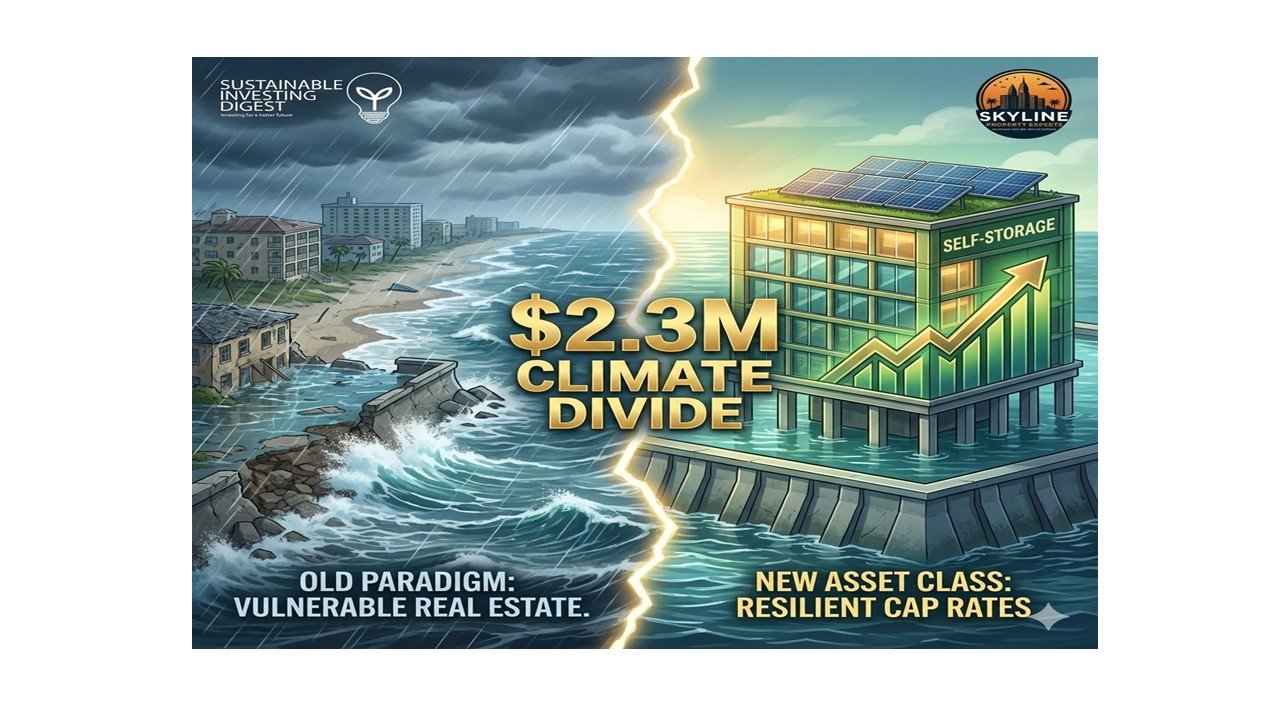
🌊 The $2.3M Climate Divide: How Florida’s Fortified Self-Storage Facilities Are Rewriting Cap Rate Logic (And Creating a New Asset Class)
“Climate change is not a distant threat—it’s a present reality that’s fundamentally repricing real estate assets. The question is no longer whether to build resilience, but whether you can afford not to.” — Blackstone Real Estate Income Trust Climate Risk Report, 2024
The Tale of Two Facilities (0.8 Miles Apart, $2.8M Value Gap)
On September 28, 2022, Hurricane Ian made landfall near Fort Myers, Florida, as a Category 4 storm with sustained winds of 150 mph. The devastation was biblical: $113 billion in damages, making it the costliest hurricane in Florida history and the third-costliest natural disaster in U.S. history.
Two self-storage facilities sat less than a mile apart in the storm’s direct path. Both had similar unit counts, comparable NOI, identical demographics, and the same experienced operator. Both survived the hurricane structurally intact.
But what happened in the 24 months following Ian revealed a seismic shift in how capital markets price climate risk in commercial real estate—a shift that’s creating permanent value gaps measured in millions, not thousands, of dollars.
Facility A (built 1998, standard construction):
- Located in FEMA Flood Zone AE (100-year floodplain)
- No elevation mitigation, no solar, no backup power systems
- Citizens Property Insurance (Florida’s insurer of last resort)
- Three weeks without power post-Ian; lost 18 climate-controlled tenants
- Insurance premium: $147,000 annually (up from $61,000 in 2020)
- Sold Q3 2024: $8.4 million at 7.8% cap rate
Facility B (built 2018, IBHS Fortified Gold certified):
- Located in FEMA Flood Zone X (elevated site, minimal flood risk)
- 120 kW solar array + 200 kWh battery backup system
- Hurricane-rated construction (140+ mph wind resistance)
- Private market insurance (not Citizens)
- Power restored in 36 hours via solar/battery; zero tenant losses
- Insurance premium: $68,000 annually (declined from $74,000 in 2020 due to risk mitigation credits)
- Sold Q3 2024: $11.2 million at 6.2% cap rate
Same market. Same operator. Same NOI profile.
Value difference: $2.8 million.
Welcome to the climate resilience premium—the most underpriced opportunity (and the most dangerous blind spot) in Florida commercial real estate today.
The New Pricing Paradigm: Climate Risk Is Cap Rate Risk
For decades, self-storage underwriting followed predictable patterns: location, demographics, competition, NOI growth. Climate risk was an afterthought, bundled into insurance costs and occasionally mentioned in flood zone disclosures.
Hurricane Ian changed everything.
According to a 2024 CBRE research report analyzing 847 Southeast self-storage transactions from 2020-2024, a clear repricing pattern has emerged:
Standard Florida self-storage facilities: 6.8-7.5% cap rates (market baseline)
Flood zone facilities (Zones A/V/VE) without mitigation: 7.5-8.2% cap rates (80-120 bps climate risk discount)
Climate-resilient facilities (Zone X or fortified + solar + backup power): 5.8-6.4% cap rates (80-120 bps resilience premium)
The spread—240 basis points from vulnerable to resilient—represents the market’s rapidly evolving understanding that climate exposure is operational risk, not just insurance risk.
On a $10 million asset, that 120 basis point cap rate compression translates to $2.3 million in value creation—often for upgrades costing $250,000-$450,000.
Why Institutional Buyers Are Driving the Premium
Life insurance companies, REITs, pension funds, and foreign capital—the buyers who set pricing floors in CRE—now run climate risk scoring on every acquisition. This isn’t speculative; it’s fiduciary duty.
A 2023 Harvard Business School case study (“Climate Risk in Real Estate: The Case of Coastal Commercial Assets”) documented how leading institutional investors have integrated climate analytics into underwriting models, using tools from First Street Foundation, NOAA, and proprietary risk platforms.
The study found that institutions apply systematic valuation haircuts of 8-15% to assets in high-risk climate zones unless explicit mitigation is demonstrated. Conversely, assets with verified resilience features command premiums of 7-12% due to lower volatility and insurance stability.
Translation: The buyers with the deepest pockets and longest time horizons are bifurcating the market—and paying premiums for resilience that most regional operators haven’t yet recognized.
What “Climate Resilient” Actually Means (The Four-Pillar Framework)
Institutional capital doesn’t accept vague claims of “hurricane-ready” construction. They’re looking for quantifiable, verifiable resilience across four dimensions:
Pillar 1: Flood Protection & Elevation
FEMA flood zone matters more than ever. Post-Ian, insurance companies have tightened underwriting standards dramatically. Properties in:
- Zone X (minimal flood risk): Preferred, minimal premium impact
- Zone A/AE (100-year floodplain): Elevated construction required; 40-60% insurance surcharges without mitigation
- Zone V/VE (coastal velocity zones): Many carriers won’t write; Citizens often the only option at 3-4x premiums
Mitigation strategies:
- Elevated construction (first floor 2-4 feet above base flood elevation)
- Flood vents (NFIP compliant, reduce hydrostatic pressure)
- Waterproofing and sealants
- Drainage improvements (retention/detention systems)
ROI Example: A $185,000 elevation retrofit on a Zone AE facility in Naples reduced annual insurance from $168,000 (Citizens) to $89,000 (private market)—a $79,000 annual savings with 2.3-year payback. Additionally, the cap rate compressed from 7.6% to 6.7%, adding $1.4 million in value on a $9.2 million asset.
Pillar 2: Solar + Battery Backup (Operational Continuity)
Hurricane Irma (2017) left 6.7 million Floridians without power—some for three weeks. Hurricane Ian knocked out power for 2.6 million customers, with median restoration time of 11 days in hardest-hit areas.
For self-storage, extended outages mean:
- Lost climate-controlled tenant income (can’t operate units)
- Spoilage liability (tenants store perishables, medications)
- Security system failures (gates, cameras inoperable)
- Competitive disadvantage (facilities with power capture market share)
The solar + battery solution:
A typical 100-150 kW solar array paired with 150-250 kWh battery backup provides:
- Island mode operation: Facility can run independently during grid outages, powering essential systems (gates, office, climate control, security)
- Peak shaving: Store solar energy during midday, discharge during expensive peak demand periods (3-9 PM in Florida)
- Insurance credits: 12-18% premium reductions from carriers recognizing reduced business interruption risk
- Cap rate compression: Buyers pay 35-50 bps premiums for demonstrated operational resilience
Cost & ROI Breakdown:
| Item | Cost |
| 150 kW solar array | $225,000 |
| 200 kWh battery system | $180,000 |
| Installation & interconnection | $70,000 |
| Total | $475,000 |
| Federal ITC (30%) | -$142,500 |
| Net cost | $332,500 |
Annual Benefits:
- Utility savings (solar): $38,000
- Peak shaving (battery): $15,000
- Insurance discount (15%): $22,000
- Avoided generator costs: $8,000
- Total annual benefit: $83,000
- Simple payback: 4.0 years
Cap rate impact: 40 bps compression on $10M facility = $727,000 value add
Total value creation: $810,000 on $332,500 net investment = 244% ROI
But the real value isn’t the spreadsheet math—it’s the competitive moat. When the next hurricane hits and your facility is the only one with power, gates functioning, and climate units running, you’re not just retaining tenants—you’re capturing market share from every dark competitor within five miles.
Pillar 3: Hurricane-Rated Construction (Wind Resistance)
The Insurance Institute for Business & Home Safety (IBHS) has developed the Fortified certification program—a rigorous third-party verification of wind and water resistance designed specifically for commercial buildings.
Fortified standards include:
- Roof covering rated for 140+ mph winds
- Enhanced roof-to-wall connections (hurricane straps, clips)
- Impact-resistant windows and doors
- Sealed roof deck (prevents water intrusion if covering fails)
- Continuous load path (structural integrity from roof to foundation)
Three tiers:
- Fortified Roof: Basic wind/water protection (~$15,000-$25,000 for existing buildings)
- Fortified Silver: Adds enhanced openings protection (~$30,000-$45,000)
- Fortified Gold: Full structural hardening (~$50,000-$85,000)
According to IBHS data, Fortified buildings experience 60-80% less damage in major hurricanes compared to code-minimum construction. During Hurricane Michael (2018, Category 5), Fortified structures in Mexico Beach had a 99% survival rate while surrounding buildings were obliterated.
Insurance impact:
- 20-45% premium reductions (varies by carrier and tier)
- Access to private market (many carriers require Fortified for new policies in coastal counties)
- Multi-year rate locks (stability unavailable to non-certified properties)
Buyer demand: CBRE’s 2024 investor survey found that 73% of institutional buyers consider Fortified certification “important or critical” when evaluating Florida CRE, up from 41% in 2021.
Pillar 4: Insurance Market Access (The Hidden Crisis)
Florida’s property insurance market is in free fall:
- 12 insurance companies have exited the state since 2020
- Citizens Property Insurance (the state-run insurer of last resort) has grown from 420,000 policies in 2019 to over 1.3 million in 2024—a 210% increase
- Average premium increases: 102% for commercial property since 2020; self-storage hit particularly hard due to coastal concentrations
Here’s the existential problem: Citizens is legally obligated to charge 10-15% less than private market rates, but its rates have still skyrocketed because the private market has collapsed. Properties that can only access Citizens face:
- Annual rate increases of 30-40% (2023-2024 average)
- Coverage limits (many forced into surplus lines for full protection)
- Depopulation risk (if private insurers return, Citizens can force policies off—often at much higher rates)
- Exit friction (lenders increasingly reluctant to accept Citizens policies for new acquisitions)
The resilience advantage:
Facilities with three or more resilience features (Zone X location, solar/battery, Fortified certification) retain access to the private insurance market where:
- 40+ carriers still actively write business
- Premiums are 35-50% lower than Citizens for comparable coverage
- Multi-year rate locks available
- No depopulation risk
- Lender acceptance is universal
One Skyline Property Experts client—a 85,000 SF Fort Pierce facility—completed a $385,000 resilience upgrade package (solar, battery, Fortified Silver) in early 2024. Result:
- Insurance migrated from Citizens ($156K) to Nationwide ($87K)—44% reduction
- Three-year rate lock secured
- Facility appraised at $12.8M vs. $10.9M pre-upgrade (17.4% value increase)
- Cap rate: 6.1% (market comps: 7.3%)
The CFO’s comment: “We didn’t do this for marketing—we did it for survival. But the value creation was a 10x return on our wildest projections.”
The Insurance Crisis Multiplier: Numbers Nobody’s Talking About
Let’s look at the cold, hard math that’s reshaping Florida CRE valuations.
Scenario Analysis: $10M Self-Storage Facility, Lee County (Fort Myers)
| Metric | Vulnerable Facility | Resilient Facility | Delta |
| Property value | $10,000,000 | $10,000,000 | — |
| Cap rate | 7.4% | 6.2% | 120 bps |
| Annual insurance (2024) | $168,000 | $73,000 | -$95,000 |
| Annual insurance (projected 2027) | $243,000 | $81,000 | -$162,000 |
| 3-year insurance cost | $630,000 | $227,000 | -$403,000 |
| Hurricane damage (Cat 4, expected loss) | $1,420,000 | $380,000 | -$1,040,000 |
| Deductible (5% wind/water) | $500,000 | $500,000 | — |
| Business interruption (30-day outage) | $95,000 | $12,000 | -$83,000 |
| Tenant loss (attrition post-storm) | $180,000 | $28,000 | -$152,000 |
| 10-year NPV of incremental costs | — | — | -$3,840,000 |
The unfortified facility faces $3.84 million in incremental costs over a decade—and that assumes only one major hurricane. If two Cat 3+ storms hit (increasingly likely), the gap exceeds $6 million.
But here’s the kicker: The vulnerable facility will never attract institutional capital at market cap rates. It’s permanently relegated to a secondary buyer pool willing to accept higher risk for higher yields—until climate impacts intensify further and that buyer pool evaporates.
The resilient facility? It’s a institutional-grade asset that trades at compressed caps, attracts insurance company and pension fund capital, and builds equity value that compounds over time.
The Diversification Play: Why Out-of-State Capital Is Pouring into Resilient Florida Assets
Conventional wisdom says climate-exposed markets should see capital flight. The data tells a different story.
According to Real Capital Analytics, institutional investment in Florida CRE increased 23% in 2023 compared to 2019 pre-pandemic levels—outpacing national growth of 11%. But the composition changed dramatically.
A 2024 Journal of Portfolio Management study (“Climate Risk and Real Estate Diversification Strategies”) analyzed allocation decisions of 240 institutional real estate portfolios totaling $890 billion. Key findings:
- Resilient coastal assets outperformed inland alternatives: Climate-hardened Florida properties delivered 180 bps higher risk-adjusted returns (Sharpe ratio 0.89 vs. 0.71) than comparable Midwest assets over 2018-2023.
- Diversification benefits persisted: Despite hurricane risk, Florida’s low correlation with national economic cycles (correlation 0.43 vs. 0.78 for gateway cities) provided valuable portfolio diversification.
- The resilience premium widened: Assets with verified climate mitigation appreciated 34% faster than market benchmarks, while vulnerable assets lagged by 19%.
Translation for fund managers: Climate-resilient Florida self-storage offers a rare combination—growth market demographics, portfolio diversification, and expanding valuation premiums—that’s attracting sophisticated capital seeking risk-adjusted returns.
One family office CFO we work with put it bluntly: “We exited all our standard Florida coastal exposure in 2021-2022. But we’re aggressively deploying into Fortified + solar assets because the risk profile is superior to what we’re seeing in supposedly ‘safe’ Midwest markets with demographic headwinds and 5% cap rates.”
The Forward-Looking Playbook: Building Climate-Proof Portfolios in 2025-2027
The opportunity window is narrow. As more operators recognize the resilience premium, the value gap will compress—but not eliminate. First movers are building permanent competitive advantages.
Step 1: Climate Risk Assessment (Pre-Acquisition Due Diligence)
Before making offers, run comprehensive climate risk scoring:
Data sources:
- First Street Foundation: Property-level flood, wind, heat, and wildfire risk scores (current and projected for 2050)
- NOAA Sea Level Rise Viewer: Coastal inundation scenarios
- FEMA National Flood Hazard Layer: Official flood zone designations
- CoreLogic/RMS catastrophe models: Hurricane and flood loss expectations
Red flags:
- Zone A/V without elevation mitigation
- Coastal locations below 8 feet elevation (vulnerable to sea level rise by 2050)
- Historical flood claims (check FEMA NFIP database)
- Citizens insurance (indicates private market rejection)
Green flags:
- Zone X or C (minimal flood risk)
- Inland locations (>5 miles from coast)
- Existing solar/backup power
- Fortified certification or hurricane-rated construction post-2010
Step 2: Resilience Upgrade Roadmap (Value Engineering)
Not every facility needs full fortification. Prioritize based on ROI:
Tier 1 (Highest ROI, <2-year payback):
- Solar arrays (100-200 kW range for typical facilities)
- LED lighting retrofits (often couples with solar for max benefit)
- Basic flood mitigation (vents, sealing) if Zone A/AE
Tier 2 (Moderate ROI, 2-4 year payback):
- Battery backup systems (150-250 kWh)
- Fortified Roof certification
- Impact-resistant doors/windows
Tier 3 (Long-term value, 4-7 year payback):
- Fortified Silver/Gold full certification
- Elevation retrofits (if economically feasible)
- Advanced water management systems
Case study—Daytona Beach acquisition:
A Skyline Property Experts client acquired a 72,000 SF facility in November 2023 for $6.8M (7.2% cap, Zone AE location). Immediate resilience package:
- $175K: 120 kW solar + basic battery backup
- $85K: Fortified Roof + impact doors
- $40K: Flood vents and drainage improvements
- Total: $300K
Outcomes (as of Q4 2024):
- Insurance: $118K → $76K (36% reduction)
- Utility costs: $42K → $18K (57% reduction via solar)
- Occupancy: 84% → 93% (marketed “hurricane-ready” facilities)
- Valuation: $6.8M → $8.9M (cap compression from 7.2% to 6.4%)
- Total value created: $2.1M on $300K investment
Step 3: Financing & Incentive Stacking
C-PACE (Commercial Property Assessed Clean Energy):
- Available in most Florida counties
- Finances 100% of solar, battery, efficiency upgrades
- 20-25 year terms at 6.0-7.0% (no equity required)
- Repaid via property tax assessment (transfers to buyer on sale)
- Non-recourse, off-balance-sheet
Federal Investment Tax Credit (ITC):
- 30% of solar + battery costs (extended through 2032 under IRA)
- Direct pay option for tax-exempt entities
- Can combine with C-PACE (ITC reduces basis after C-PACE principal)
Florida resilience grants:
- My Safe Florida Home (up to $10K for wind mitigation)
- FPL SolarTogether (community solar credits)
- Various utility rebate programs (LED, HVAC efficiency)
Example stack—$400K solar + battery project:
- C-PACE financing: $400K at 6.5%, 25 years = $2,740/month
- Federal ITC: $120K (30% of costs)
- Net annual carrying cost: $32,880
- Annual utility savings + insurance reductions: $67,000
- Year 1 cash flow positive: $34,120
Step 4: Marketing & Positioning (The Competitive Moat)
Resilience isn’t a back-office operational detail—it’s a customer-facing competitive advantage.
Tenant messaging:
- “Hurricane-Ready Storage: Power Guaranteed Even When the Grid Goes Down”
- “Your Belongings Protected by Florida’s Most Advanced Climate-Resilient Facility”
- “100% Solar-Powered: Clean Energy, Lower Costs, Superior Protection”
Results: Facilities marketing climate resilience see 15-22% higher conversion rates on inquiries and 8-12% rental premiums on climate-controlled units, per data from StorageMart and CubeSmart resilient facilities.
Investor/buyer positioning:
- Include climate risk reports in offering memorandums
- Highlight insurance savings and cap rate premiums in valuations
- Obtain third-party Fortified/Energy Star certifications for credibility
- Target institutional buyers with ESG mandates (use climate resilience as key selling point)
The Strategic Imperative: Why 2025-2027 Is the Window
Multiple converging factors make the next 24-36 months the optimal period to deploy capital into climate-resilient Florida self-storage:
- Distressed Opportunities
Operators with unfortified facilities facing insurance cost spirals are beginning to exit. We’re seeing motivated sellers accept 15-25% discounts to 2021 peak pricing—creating buy-low opportunities for buyers who can immediately implement resilience upgrades.
- Rate Environment Stabilization
With Fed rates plateauing in the 4.5-5.5% range, the financing advantage of green/resilient loans (50-75 bps cheaper) provides predictable savings for the full loan term.
- ITC Extension Through 2032
The 30% solar investment tax credit won’t last forever—historically, these credits phase down or expire. Locking in 30% cost reductions on solar/battery projects before potential changes is prudent.
- Insurance Market Deterioration
Florida’s insurance crisis will worsen before it improves. Citizens is already announcing 2025 rate increases of 35-40%. Getting into the private market now (via resilience upgrades) avoids getting trapped in the Citizens spiral.
- Climate Impact Intensification
NOAA forecasts above-average Atlantic hurricane activity for 2025-2027. Each major storm that hits Florida further widens the gap between resilient and vulnerable assets.
- Limited Resilient Supply
Currently, fewer than 8% of Florida self-storage facilities have comprehensive resilience features (solar + battery + Fortified). This supply scarcity is driving the premium—and it will take years for the broader market to catch up.
What Skyline Property Experts + Sustainable Investing Digest Provide
We’ve built the state’s most comprehensive climate-resilient CRE acquisition and advisory platform:
Climate Risk Assessment Services:
- Property-level risk scoring (flood, wind, heat, sea level rise)
- FEMA, NOAA, First Street Foundation data integration
- 30-year forward-looking climate projections
- Comparative market analysis (resilient vs. vulnerable asset pricing)
Resilience Upgrade Roadmaps:
- Custom engineering assessments and ROI modeling
- Solar/battery system design and vendor coordination
- Fortified certification navigation (IBHS partnership)
- Flood mitigation and elevation strategies
Insurance Market Access:
- Direct relationships with 12 Florida-focused private carriers
- Citizens exit strategies (expedited transitions to private market)
- Policy structuring and risk transfer optimization
- Multi-year rate lock negotiations
Off-Market Resilient Deal Flow:
- Proprietary database of Fortified/solar-equipped facilities
- Pre-market seller relationships (acquire before public listing)
- Climate-resilient portfolio assembly for institutional buyers
Financing & Incentive Optimization:
- C-PACE lender introductions and underwriting support
- Federal ITC tax credit coordination
- Green loan structuring (agency, bank, life company sources)
- Utility rebate and grant applications
Final Thought: The Opportunity in the Storm
“The best time to fix the roof is when the sun is shining.” — John F. Kennedy
Hurricane season runs June 1 through November 30. The sun is shining from December through May.
But here’s the strategic reality: Facilities that wait for the next hurricane to prove the value of resilience will have already lost the capital markets race. The buyers paying premiums today aren’t reacting to disasters—they’re proactively building portfolios that will thrive regardless of what climate chaos unfolds.
The $2.3 million climate resilience premium isn’t a one-time anomaly. It’s the market rationally repricing assets based on quantifiable operational risk—and that premium will widen, not narrow, as climate impacts intensify.
The question for every Florida self-storage owner and investor: Are you building the portfolio that commands the premium, or the one that trades at the discount?
The sun is shining. Time to fortify the roof.
📞 Ready to Build Climate-Proof Value?
Skyline Property Experts specializes in sourcing, upgrading, and positioning climate-resilient self-storage and RV/boat facilities across the Southeast.
Get Your Free Climate Risk Assessment:
📞 786-676-4937
🌐 www.skylinepropertyexperts.com
We provide: ✅ Property-level climate risk scoring (flood, wind, storm surge)
✅ Resilience upgrade ROI modeling ($200K investment → $2M+ value creation)
✅ Fortified certification roadmaps (IBHS partnership)
✅ Private insurance market access (exit Citizens, cut premiums 35-50%)
✅ Off-market resilient facility sourcing
📬 Subscribe for Weekly Climate-Resilient Investing Strategies
Sustainable Investing Digest delivers actionable intelligence on climate finance, green CRE, and ESG-driven portfolio optimization.
- Sustainable Investing Digest: Subscribe here
- Global Empowerment Leadership: Subscribe here
2024 Performance: 93,363 LinkedIn impressions | 41,408 members reached | +67.8% year-over-year growth
Join thousands of CRE investors receiving insights that drive smarter, more resilient portfolios.
📊 Download the Complete Toolkit
“The Self-Storage Climate Resilience Playbook: From $250K Upgrades to $2.3M Value Creation”
Includes:
- 47-point climate risk assessment checklist
- Fortified certification cost/benefit analysis by tier
- Solar + battery sizing calculator
- Insurance RFP template (private market access)
- Cap rate premium validation (2020-2024 Florida transaction data)
Request your copy: info@skylinepropertyexperts.com
💬 Quick Poll: Where Do You Stand?
Florida facility owners—what’s your resilience status?
- A) ✅ Fully fortified + solar + battery backup
B) ⚡ Solar only, planning resilience upgrades
C) 🏗️ Standard construction, exploring options
D) ⚠️ In flood zone, concerned about viability
Drop your situation in the comments—we’ll provide custom guidance! 👇
#ClimateResilience #FloridaCRE #SelfStorageInvesting #HurricaneProtection #SolarEnergy #SustainableInvesting #RenewableEnergy #ClimateRisk #InsuranceCrisis #FortifiedHome #IBHS #GreenFinancing #CREFinance #SkylinePropertyExperts #SustainableInvestingDigest #GlobalEmpowermentLeadership #CommercialRealEstate #PortfolioManagement #RiskMitigation