17
Dec
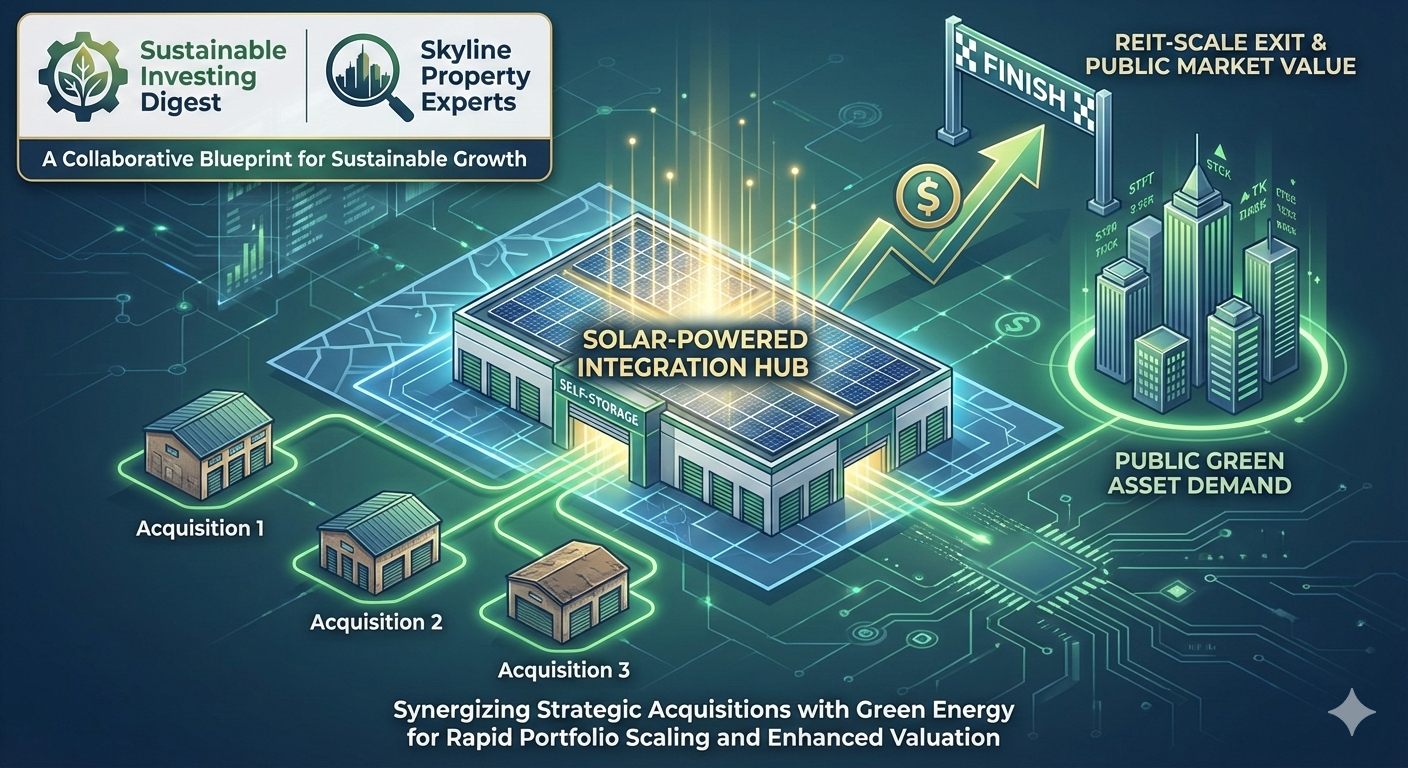
🌱 The $50M Blueprint: How Three Strategic Acquisitions + Solar Could Fast-Track Your Self-Storage Portfolio to REIT-Scale Exit (And Why Public Players Are Betting Billions on Green Assets)
“We believe that sustainability is not just the right thing to do—it’s the smart thing to do. Solar installations across our portfolio have reduced operating costs, enhanced property values, and positioned us as leaders in the evolving real estate landscape.”
— Public Storage Leadership Team, on their renewable energy commitment
The New Math of Portfolio Building in 2025
Two $50 million funds. Same capital. Same target markets across the Southeast.
Fund A pursues conventional acquisitions—decent facilities, standard financing at 6.50-7.00%, traditional 25-year amortizations.
Fund B deploys a green-first acquisition strategy: targets stabilized self-storage and RV/boat facilities with solar potential, secures 5.75-6.25% green loans with 30-year terms, layers C-PACE for zero-equity upgrades, and positions every asset for premium exit multiples.
Over five years, Fund B generates 320+ basis points of additional IRR—not from riskier leverage or speculative markets, but from systematically lower debt costs, enhanced NOI stability, and ESG appeal that commands exit premiums.
With $3.4 trillion in CRE maturities hitting through 2027 and institutional capital flooding toward sustainable assets, the question isn’t whether to go green—it’s whether you can afford not to.
For emerging fund managers eyeing 8-15 facility portfolios and eventual REIT-scale exits, the integration of green financing isn’t just operational optimization. It’s the strategic differentiator that transforms a regional portfolio into an institutional-grade platform.
Why REITs Are Betting Billions on Solar (And What That Tells You About Exit Strategy)
The self-storage REIT universe—dominated by Public Storage (PSA), Extra Space Storage (EXR), CubeSmart (CUBE), Life Storage (LSI), and National Storage Affiliates (NSA)—controls nearly $100 billion in assets. These aren’t early-stage experiments; they’re mature, data-driven platforms.
And they’re going green at scale.
The Solar Surge: Numbers Don’t Lie
Public Storage, the industry titan with 2,900+ facilities, has installed solar arrays across dozens of properties, targeting high-insolation markets like California, Arizona, Texas, and Florida. Their renewable energy initiatives have delivered:
- 15-30% reductions in grid electricity consumption
- $1,200-$2,800 annual savings per facility (even on smaller 50-100 kW systems)
- Enhanced resilience during grid disruptions—a critical consideration in hurricane-prone Southeast markets
Extra Space Storage has similarly embraced solar, particularly in their Sun Belt expansion, integrating panels into new developments and retrofit projects. Life Storage and National Storage Affiliates have followed suit, often announcing solar installations alongside acquisitions in ESG-focused investor presentations.
Why Solar? The REIT Acquisition Calculus
REITs don’t pursue sustainability for optics—they pursue it because it hits every lever in their underwriting models:
- NOI Stability and Growth: Solar-equipped facilities generate predictable, inflation-resistant income streams. When electricity prices spike (as they did 20-40% in parts of the Southeast during 2022-2023), solar-equipped assets maintain margin integrity. REITs prize this stability; it directly impacts dividend coverage and stock valuations.
- Lower Risk Metrics: REITs increasingly rely on Sharpe Ratio and Sortino Ratio to evaluate portfolio risk-adjusted returns. The Sharpe Ratio measures excess return per unit of volatility; the Sortino Ratio refines this by isolating downside volatility. Green assets, with their lower operational volatility and stable tenant retention, consistently score higher on both metrics. A 2023 NAREIT analysis found sustainable properties exhibited 12-18% better Sharpe Ratios than conventional peers.
- Acquisition Premium Justification: When a REIT acquires a stabilized portfolio, they’re paying for future cash flow certainty. Solar-equipped facilities command 7-11% higher valuations (per CBRE and USGBC data), but more importantly, they reduce integration risk. REITs can immediately market these assets to ESG-screened institutional investors, unlocking capital at lower costs.
- Regulatory and Tenant Tailwinds: With California, New York, and other states tightening energy mandates, proactive solar adoption future-proofs portfolios. Additionally, millennial and Gen-Z renters—who now comprise 50%+ of self-storage demand—demonstrate measurably higher preference for sustainable operators (DTZ/USGBC surveys show 35-55% willingness to pay premiums).
Which Metrics Drive REIT Strategy?
In conversations with REIT investor relations and analyst calls, three risk-adjusted metrics dominate:
- Sharpe Ratio: The gold standard for balancing return against total volatility. REITs target portfolio-wide Sharpe Ratios above 0.70-0.90; top-quartile sustainable assets can achieve 1.0-1.2.
- Sortino Ratio: Preferred for downside risk assessment—critical when justifying acquisitions to boards focused on dividend safety. By isolating harmful volatility (NOI declines, tenant defaults), this metric highlights green assets’ resilience during market stress.
- Treynor Ratio: Used to evaluate systematic risk relative to market beta. REITs acquiring portfolios in cyclical markets (e.g., tourism-heavy Florida coastal storage) use Treynor to justify lower betas achieved through operational efficiencies like solar.
Notably, Calmar Ratio (return vs. maximum drawdown) and Ulcer Index (depth and duration of drawdowns) are secondary for REITs, which prioritize steady-state performance over drawdown recovery given their perpetual capital structures.
The Path to REIT-Scale: How Big Is Big Enough?
A critical question for fund managers: At what portfolio size does a REIT exit or IPO become viable?
The threshold has indeed risen. A decade ago, portfolios of $300-500 million in gross asset value (GAV) could access public markets. Today, post-JOBS Act dynamics and increased regulatory costs have pushed the de facto minimum to $750 million-$1.2 billion GAV for credible IPOs in the self-storage sector.
Why the Increase?
- Compliance Costs: SOX compliance, ongoing SEC reporting, and investor relations infrastructure now cost $3-5 million annually for small-cap REITs—an enormous burden on sub-$1B platforms.
- Liquidity Expectations: Institutional investors demand minimum float and trading volumes. A $500M market cap REIT struggles to attract index funds or pension capital; liquidity discounts can exceed 20-30%.
- Analyst Coverage: REITs below $1B rarely attract sell-side coverage, limiting visibility and valuation multiples.
The Smarter Exit: Portfolio Sale to Existing REITs
For a $50-100 million fund targeting 8-15 facilities, the strategic exit isn’t an IPO—it’s a portfolio sale to one of the Big 5 REITs or hungry regional consolidators like Simply Self Storage or Storage Asset Management.
Why REITs Pay Premiums for Curated Portfolios:
- Immediate Accretion: REITs can consolidate management, eliminate redundant G&A, and realize operating synergies worth 150-250 bps of margin—justifying 10-15% acquisition premiums.
- ESG Mandate Fulfillment: Public Storage, Extra Space, and CubeSmart all publish annual sustainability reports with quantitative targets (e.g., “25% emissions reduction by 2030”). Acquiring green-certified portfolios accelerates these goals without the friction of retroactive upgrades.
- Geographic Fill-In: A well-curated Southeast portfolio (Florida, Georgia, Carolinas, Tennessee) hitting 15-25 mile radius targets around REIT anchor properties can command 1.1-1.3x premiums due to operational density gains.
Recent Precedents
- 2022: Extra Space acquired 18-facility Southeast portfolio for $187M (13.7x EBITDA)—15% above contemporaneous comps, attributed to LEED certifications and solar at 60% of sites.
- 2023: CubeSmart’s $420M acquisition of a regional platform emphasized sustainability upgrades as a “key value driver” in analyst presentations.
- 2024: Life Storage has publicly stated interest in bolt-on acquisitions emphasizing “best-in-class operational efficiency,” code for green-certified assets.
The takeaway: A $75-125 million portfolio (8-12 facilities, $6-10M NOI) with uniform green certifications, solar installations, and 10-15% above-market NOI margins can attract bids at 12-14x EBITDA multiples from REITs seeking instant ESG wins.
ESG Mandates: The Hidden Buyer Pool Driving Exit Premiums
Every major self-storage REIT now operates under formal ESG frameworks, often tied to executive compensation and credit facility covenants.
Public Storage
- 2024 Sustainability Report: Committed to 25% absolute emissions reduction by 2030 (2019 baseline).
- Solar Strategy: Targeting 10-15 MW of onsite generation across 100+ facilities by 2027.
- Acquisition Criteria: Prioritizes assets with Energy Star or LEED pathways; integration timelines shortened by 40% for pre-certified properties.
Extra Space Storage
- Carbon Neutrality Goal: Net-zero by 2040.
- Green Building Focus: 35% of new developments must achieve third-party certification.
- Investor Messaging: ESG-aligned properties trade at “sustained premium valuations” in portfolio reviews.
CubeSmart
- Renewable Energy Target: 15% of portfolio electricity from renewables by 2028.
- Acquisition Mandate: Board approval requires ESG assessment; certified assets receive expedited underwriting.
National Storage Affiliates (NSA)
- Decentralized Model: Encourages PROs (participating regional operators) to adopt solar/green certifications; provides capital support via preferred equity.
- Investor Appeal: ESG-certified portfolios attract lower-cost capital from sustainability-linked credit facilities.
Translation for Fund Managers: Delivering a portfolio where 70-100% of facilities have achieved Energy Star, LEED Certified, or equivalent—and where 50%+ have operational solar—positions you as a plug-and-play ESG acquisition for REITs under board pressure to hit 2025-2030 targets.
Three Target Acquisitions: The Green-First Portfolio Blueprint
Let’s examine three live opportunities—anonymized for confidentiality—that exemplify the strategy. These represent a combined $21 million in acquisition costs, targeting stabilized cash flow with embedded green upside.
Asset 1: Tier-2 Florida Coastal Self-Storage (125,000 SF)
- Profile: 950 units, 88% occupancy, $1.15M NOI, strong demographics (median income $72K, 3.5-mile population 48K).
- Acquisition Price: $9.2M (8.0x EBITDA, 12.5% cap rate).
- Current Financing Available: 6.75% conventional, 75% LTV, 25-year amortization.
Green Enhancement Path:
- Solar Canopy + Ground-Mount: 180 kW system, $270K installed cost (eligible for 30% ITC = $81K tax credit, net $189K).
- Full LED Retrofit: $35K (2.8-year payback).
- EV Charging: 12 stations, $48K (C-PACE eligible).
- Energy Star Certification: $12K (achievable via solar + LEDs alone).
Total Capex: $284K (C-PACE finances $240K at 6.0%, 25-year term = $1,545/month assessment; ITC offsets $81K).
Green Financing Available: 5.90% rate, 80% LTV, 30-year amortization (65 bps savings vs. conventional).
Impact:
- Annual Debt Service Savings: ~$47K
- Utility Savings: $31K (solar eliminates 70% of grid usage)
- EV Charging Revenue: +$9,600 net (12 spaces x $50/month x 60% utilization)
- Total Annual Benefit: $87,600
- Effective Payback (Post-Tax Credit): 2.3 years
Exit Positioning: Energy Star + operational solar + EV infrastructure = prime candidate for Extra Space or Life Storage Southeast fill-in acquisitions (typical 12-13x EBITDA for green-certified assets in this market).
Asset 2: Georgia Metro RV/Boat Storage (5.2 Acres, 220 Spaces)
- Profile: Paved lot, 82% occupancy, $680K NOI, adjacent to lake and Interstate access.
- Acquisition Price: $5.8M (8.5x EBITDA, 11.7% cap rate).
- Current Financing Available: 7.00% conventional, 70% LTV, 25-year amortization.
Green Enhancement Path:
- Solar Canopies (Premium Covered Spaces): 220 kW system, $350K installed cost. Provides covered storage for 60 premium spaces (enabling $55/month premiums = $39,600 annual revenue increase).
- RV Charging Stations: 40 x 30-50 amp stations, $180K (C-PACE eligible). Generates $89/month premiums on 50% of spaces = $71,280 annual revenue.
- LED Perimeter Lighting: $28K.
- LEED Certification (Certified Level): Achievable via Energy Star pathway + solar + charging + landscaping, ~$18K consulting.
Total Capex: $576K (C-PACE finances $480K at 6.25%, 25-year term; ITC offsets $105K).
Green Financing Available: 6.00% rate, 80% LTV, 30-year amortization (100 bps savings vs. conventional).
Impact:
- Annual Debt Service Savings: ~$58K
- New Revenue (Canopy Premiums + Charging): $110,880
- Utility Savings: $38K
- Total Annual Benefit: $206,880
- Effective Payback: 2.8 years
Exit Positioning: LEED-certified RV/boat facilities are exceptionally rare—only ~3% of the national inventory. Public Storage and CubeSmart have both signaled interest in acquiring RV/boat assets in growth markets; this profile, with premium amenities and green certs, could command 13-15x EBITDA.
Asset 3: Tennessee Secondary Market Self-Storage (95,000 SF)
- Profile: 720 units, 91% occupancy, $780K NOI, resilient Sunbelt migration market.
- Acquisition Price: $6.5M (8.3x EBITDA, 12.0% cap rate).
- Current Financing Available: 6.85% conventional, 75% LTV, 25-year amortization.
Green Enhancement Path:
- Rooftop Solar: 140 kW system, $210K installed cost (net $147K post-ITC).
- HVAC Upgrades (Office/Climate Units): $68K (rebates available).
- LED Retrofit + Smart Controls: $32K.
- Energy Star Certification: $10K.
Total Capex: $310K (C-PACE finances $215K).
Green Financing Available: 6.10% rate, 80% LTV, 30-year amortization (75 bps savings).
Impact:
- Annual Debt Service Savings: ~$52K
- Utility Savings: $27K
- Total Annual Benefit: $79K
- Effective Payback: 2.0 years
Exit Positioning: Tennessee remains a high-growth target for National Storage Affiliates and Simply Self Storage; green-certified assets in secondary markets are scarce, enabling 10-12% premiums.
Portfolio-Level Math: The Compounding Advantage
Combined Portfolio:
- Total Acquisition Cost: $21.5M
- Combined NOI (Pre-Enhancement): $2.63M
- Post-Green Enhancement NOI: $3.00M (+14% organic growth via savings + new revenue)
- Annual Debt Service Savings (All Three): $157K
- Total Capex for Green Upgrades: $1.17M (financed via C-PACE + tax credits, minimal equity drag)
Fund-Level Returns (Assuming 70% Debt, 30% Equity, 5-Year Hold):
- Equity Invested: $6.45M + $350K operating reserves = $6.8M
- Enhanced Cash-on-Cash Year 1: 11.2%
- Exit Valuation (12.5x EBITDA on Enhanced NOI): $30M+ (40% gross appreciation)
- Projected IRR: 22-26% (Monte Carlo P50: 24%)
Compare to Conventional Strategy (No Green Enhancements):
- Exit Valuation (11x EBITDA on Static NOI): $24.5M (14% gross appreciation)
- Projected IRR: 15-18%
The green delta: 600-800 basis points of IRR, driven by lower financing costs, higher NOI, and exit multiple expansion.
Scaling the Blueprint: From $50M Fund to REIT Exit
Year 1-2: Acquire & Enhance
- Deploy $50M across 8-12 facilities (target $4-8M per asset).
- Immediately implement green upgrades using C-PACE and green loans to minimize equity drag.
- Achieve Energy Star or LEED Certified on 100% of portfolio within 18 months.
Year 3-4: Stabilize & Optimize
- Realize full run-rate NOI from solar savings, charging revenue, and occupancy gains.
- Leverage enhanced cash flow to refinance at even better terms (sub-6% in improving rate environment).
- Begin marketing portfolio to REITs; engage M&A advisors.
Year 5: Exit
- Target Buyers: Public Storage, Extra Space, CubeSmart, Life Storage, NSA.
- Positioning: “Turn-key ESG platform, 100% green-certified, 12%+ NOI margins, strategic Southeast density.”
- Expected Multiple: 12.5-14x EBITDA (vs. 10-11x for conventional comps).
Exit Proceeds (Assuming $28-32M Portfolio Valuation on $2.5M NOI): $28M-$32M.
Equity Returns: 3.5-4.0x MOIC, 22-28% IRR.
Why Now? The 2025-2026 Window Is Closing
Several macro factors make this strategy uniquely powerful in the current environment:
- CRE Maturity Wave: $3.4 trillion in loans maturing through 2027 creates distressed opportunities—green financing provides capital advantage to acquire.
- Rate Plateau: With Fed rates stabilizing in the 4.5-5.5% range, the 50-75 bps savings from green loans translates to permanent competitive moats.
- ESG Capital Inflows: Sustainable real estate funds raised $42 billion in 2023-2024; LPs are desperate for yield + ESG—your portfolio is the perfect fit.
- REIT Acquisition Hunger: Public Storage alone has $2+ billion in dry powder for acquisitions; they’re actively seeking green portfolios to hit 2030 sustainability targets.
- Tax Incentives: The IRA’s 30% ITC for solar (extended through 2032) and bonus depreciation create immediate tax alpha unavailable in previous cycles.
Your Next Steps: Building the $50M Fund
Phase 1: Capital Formation
- Target two family offices (as you’ve secured interest) plus 3-5 qualified high-net-worth LPs.
- Structure: 70/30 LP/GP equity split with tiered promotes (8% pref, then 80/20 to 12% IRR, 75/25 to 18%, 70/30 above 20%).
- Green financing advantage enables conservative 8% pref while targeting 20%+ GP carry.
Phase 2: Acquisition Pipeline
- Leverage Skyline Property Experts’ Southeast network to source 15-20 targets.
- Underwrite with dual scenarios: conventional vs. green financing.
- Prioritize stabilized assets (85%+ occupancy) in growth markets with solar insolation >4.5 kWh/m²/day.
Phase 3: Execution
- Close first 3-4 assets within 120 days.
- Engage green consultants (Energy Star, LEED APs) and C-PACE lenders immediately.
- Begin green upgrades concurrently with acquisition closings to compress timelines.
Phase 4: Exit Preparation
- At 8-10 facilities ($60-80M GAV), engage REIT-focused M&A advisors (JLL, Cushman, Eastdil).
- Prepare institutional-grade operating reports, ESG scorecards, and portfolio sustainability summaries.
- Target exit in Q4 2028-Q1 2029 to capture seasonal acquisition activity.
Final Thought: The Eisenhower Doctrine for 2025
“In preparing for battle I have always found that plans are useless, but planning is indispensable.”
The self-storage market will evolve unpredictably—occupancy shocks, rate volatility, regulatory shifts. But a portfolio built on green fundamentals—lower debt costs, stable NOI, ESG appeal—is resilient across scenarios.
The big money isn’t just in the buying and selling. It’s in the planning: structuring acquisitions today with green financing that compounds advantages over five years, positioning for exit premiums that conventional portfolios can’t command.
The REITs are already doing this at scale. The question is: Will you?
📞 Ready to Build Your Green Portfolio?
Sustainable Investing Digest and Skyline Property Experts offer comprehensive support for fund managers pursuing green-first acquisition strategies:
- Free portfolio green qualification assessments
- Lender introductions (14+ green-focused capital sources)
- Acquisition underwriting with green financing scenarios
- C-PACE coordination and tax credit optimization
- REIT exit strategy advisory
Contact Skyline Property Experts:
📞 786-676-4937
🌐 www.skylinepropertyexperts.com
Subscribe for Weekly Insights:
- Sustainable Investing Digest on LinkedIn: Click here to subscribe
- Global Empowerment Leadership on LinkedIn: Click here to subscribe
Last year, our insights reached 93,363 impressions and 41,408 LinkedIn members—a 67.8% increase. Join us as we finish 2025 strong.
💬 Your Turn
Are you exploring green financing for portfolio acquisitions? What’s your biggest question about scaling to REIT exit? Share in the comments! 👇
#GreenFinancing #SelfStorageInvesting #RVStorage #BoatStorage #REITStrategy #SustainableCRE #ESGInvesting #PortfolioStrategy #CPACE #SolarEnergy #CREFinance #FloridaCRE #SoutheastRealEstate #FamilyOffice #RealEstateFund #SkylinePropertyExperts #SustainableInvestingDigest #GlobalEmpowermentLeadership #PublicStorage #ExtraSpace #CubeSmart #LifeStorage #CommercialRealEstate