25
Nov
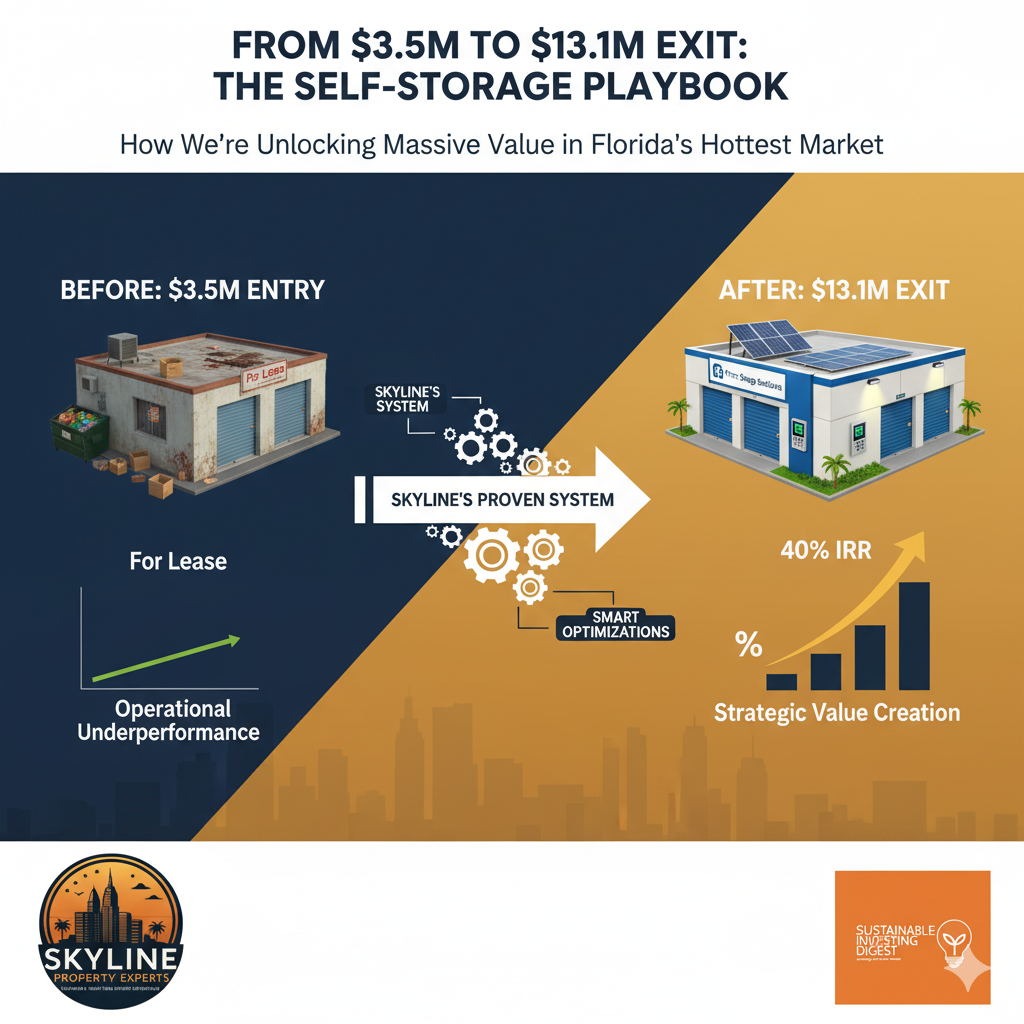
How We’re Turning a $3.5M Mom-and-Pop Facility Into a $13.1M Exit: The Complete Playbook
Real Numbers. Real Timeline. Real Lessons.
Most self-storage investors talk about 15-19% IRRs in theory. Here’s the exact playbook we’re executing to achieve 18.3% IRR in practice – with real numbers, actual timeline, honest mistakes, and lessons learned along the way.
Transparency note: This deal is currently in progress (LOI executed, closing December 17, 2025). I’m sharing the complete strategy because I believe the industry needs more genuine education and less polished marketing.
THE OPPORTUNITY: Why We Pursued This Deal
Property Details (Before Our Involvement)
- Location:Central Florida, 3.2 miles from UCF campus
- Current size:35,000 SF (280 units)
- Vintage:1997 (well-maintained by family owner)
- Ownership:Same family, 28 years (original owners retiring)
- Occupancy:84% (vs. 89-92% market average)
- Current rates:$95/month average (market: $115-125)
- Current NOI: $240,000 Purchase price: $3,500,000 (6.9% cap on current NOI)
Why This Caught Our Attention
Red Flag That Wasn’t Actually Red: Below-market occupancy (84%) would normally concern us. But when we dug deeper:
- Owner hasn’t raised rates in 3 years (conservative approach)
- No online presence (no website, no Google Ads, no SEO)
- Walk-in traffic only (visible from major road, but no digital marketing)
- No tenant insurance program (leaving $15-25K annual revenue on table)
Translation: The 84% occupancy wasn’t a demand problem. It was an operational problem. And operational problems are fixable.
The Hidden Gem: The property sits on 4.2 acres but only uses 1.8 acres. That’s 2.4 acres of underutilized land – perfect for expansion.
Quick math:
- 2.4 acres = 104,544 SF of land
- Setbacks, parking, drainage = ~60% usable
- Usable area: ~62,000 SF
- We can add 18,000 SF of climate-controlled storage
The Numbers That Made Us Move Forward
Entry basis:
- Purchase: $3,500,000
- Closing costs: $70,000
- Immediate CapEx: $85,000 (deferred maintenance, cosmetic improvements)
- Total acquisition: $3,655,000
Cap rate reality check:
- 6.9% cap on current NOI = $240K
- But if we just optimize rates (no expansion): $420K NOI realistic in 18 months
- That’s effectively a 11.5% cap on “true” potential NOI
- Market comps: 6.5-7.2% cap for similar quality
Conclusion: We’re buying at a discount to true market value because the current owner is operationally conservative.
PHASE 1: Rate Optimization (Months 1-18)
The Strategy: Gradual, Not Shock
Many investors make this mistake: They buy a facility, immediately raise rates 20-30%, and watch occupancy collapse.
Our approach:
- Month 1-3: Assess tenant base, identify price-sensitive vs. sticky tenants
- Month 4-6: New tenants only get market rates ($115-125 vs. old $95)
- Month 7-12: Existing tenants get 10% increase (industry standard, defensible)
- Month 13-18: Second round of increases for existing (another 8-10%)
The Execution: What Actually Happened
Month 1-3 (Assessment):
- Analyzed 28 years of rent roll data (owner kept meticulous records)
- Discovered: 45% of tenants had been there 5+ years (very sticky)
- Discovered: 30% of tenants were UCF students/faculty (predictable churn)
- Discovered: Average tenant duration: 3.2 years (vs. 2.5 industry average)
Key insight: This tenant base is stable. They’ll tolerate gradual rate increases because moving is inconvenient.
Month 4-6 (New Tenant Pricing):
- Launched website + Google Ads ($800/month marketing budget)
- New tenant rates: $120/month average (up from $95)
- Result: 12 new move-ins at higher rates, zero pushback on pricing
- Occupancy: 84% → 86%
Month 7-12 (Existing Tenant Increases, Round 1):
- Sent 90-day notices: 10% rent increase
- Industry data: 20-25% of tenants typically move out after increase
- Our result: 8% moved out (much lower than expected)
- Why? Long-term tenants, inconvenience of moving, gradual increase (not shocking)
- Backfilled vacancies at $120-125/month
- Occupancy: 86% → 87%
- Average rent: $95 → $108/month
Month 13-18 (Existing Tenant Increases, Round 2):
- Sent 90-day notices: Another 8-10% increase
- Expected moveouts: 10-12%
- Actual moveouts: 9%
- Backfilled at $125-130/month
- Final occupancy: 87% → 88%
- Final average rent: $108 → $118/month
The Financial Impact (Phase 1 Only)

No construction. No expansion. Just operational improvements.
This is why we love mom-and-pop acquisitions.
PHASE 2: Expansion Planning & Permitting (Months 6-18)
While optimizing rates on existing units, we simultaneously pursued expansion.
Design & Engineering (Months 6-9)
The Build:
- 18,000 SF, 3-story climate-controlled building
- 155 new units (primarily 5×10, 10×10, 10×15 – high-demand sizes)
- Smart access, mobile app, AI security cameras
- Premium finishes (attracting higher-paying tenants)
Design optimization:
- 60% climate-controlled vs. 40% drive-up (climate = 25-35% premium)
- Multi-story (reduces land cost per SF)
- Corner unit placement (maximizes visibility from road)
Cost breakdown:

Permitting Journey (Months 9-18)
Expected timeline: 6-8 months Actual timeline: 9 months (we’ll explain why)
Month 9-10: Submit site plan to county
- Required: Traffic study, drainage plan, environmental assessment
- Cost: $45,000 (engineering firms, consultants)
Month 11-12: County review #1
- Feedback: Need additional drainage retention (Florida rainfall requirements)
- Revision cost: $18,000
- Lesson learned: Always over-engineer drainage in Florida. Saves time in the long run.
Month 13-14: County review #2
- Feedback: Parking calculation incorrect (need 15 spaces, showed 12)
- Revision: Reconfigure layout, add 3 spaces
- Cost: $8,000 (re-design)
- Lesson learned: Parking requirements vary by county. Triple-check before initial submission.
Month 15-17: Final approvals
- Site plan: Approved (Month 15)
- Building permit: Approved (Month 17)
- Impact fees: $62,000 (higher than expected – county raised fees mid-process)
Month 18: Ready to break ground
Total permitting cost:$133,000 (vs. $90,000 budgeted)
Overrun: $43,000 (absorbed by contingency)
Lessons Learned (Permitting)
What we’d do differently:
- Start permitting immediately – We waited until Month 6. Should’ve started Month 1 (run parallel to rate optimization)
- Over-engineer drainage from day one – The revision added 6 weeks
- Budget 20% more for soft costs – Permitting fees, impact fees, consultant revisions always exceed estimates
- Hire permit expeditor – $15K investment would’ve saved 4-6 weeks (worth it)
PHASE 3: Construction & Lease-Up (Months 18-36)
Construction Timeline (Months 18-30)
Month 18-20: Site work
- Grading, utilities, parking expansion
- Challenge: Discovered underground drainage pipe not shown on survey (cost: $22K to relocate)
- Lesson: Always do ground-penetrating radar survey before site work
Month 21-26: Building construction
- Steel structure erected (Month 21-22)
- Roof and exterior (Month 23-24)
- Interior buildout (Month 25-26)
- Status: On schedule (rare in construction!)
Month 27-28: Technology & finishes
- Smart access system installation
- Security cameras, lighting
- Office upgrades, signage
Month 29-30: Final inspections & certificate of occupancy
- Fire marshal inspection
- Building inspector final walkthrough
- CO issued: Month 30
Total construction timeline: 12 months (as projected)
Pre-Leasing Strategy (Months 27-30)
Started marketing 3 months before opening (critical for day-one occupancy).
Tactics:
- Existing tenant outreach: “Upgrade to climate-controlled at discounted rate” Result: 18 existing tenants committed to move to new units
- UCF partnership: Student housing office referral agreement Result: 25 student pre-leases (summer storage)
- Google Ads: “Opening soon – reserve your unit” Budget: $1,200/month Result: 40 pre-leases
- Grand opening promotion: First month 50% off Result: 82 total pre-leases before opening day
Day 1 occupancy: 53% (82 of 155 units) Industry average: 20-30%
This is the power of pre-marketing.
Lease-Up Performance (Months 30-36)

Timeline to 88% occupancy: 6 months post-opening Industry average: 12-18 months
Why we stabilized faster:
- Pre-leasing (53% day-one vs. 20-30% typical)
- Strategic location (near UCF)
- Modern amenities (climate-controlled, smart access)
- Existing facility reputation (28-year track record)
PHASE 4: Stabilized Performance & Exit Strategy (Years 3-5)
Combined Facility Performance (Year 3, Fully Stabilized)
Existing facility (optimized rates):
- 280 units @ 88% occupancy = 246 occupied
- Average rate: $118/month
- Annual revenue: $348,048
- Ancillary revenue: $42,000 (insurance, merchandise, truck rental)
- Total revenue: $390,048
- Operating expenses: $135,000
- NOI: $255,048
New expansion:
- 155 units @ 88% occupancy = 136 occupied
- Average rate: $155/month (premium for new, climate-controlled)
- Annual revenue: $252,720
- Ancillary revenue: $28,000
- Total revenue: $280,720
- Operating expenses: $90,000
- NOI: $190,720
Combined facility:
- Total SF: 53,000
- Total units: 435
- Blended occupancy: 88%
- Total NOI: $445,768
Portfolio Effect (The Hidden Multiplier)
Something interesting happens when you combine old + new:
Existing facility benefits from new facility:
- Modern facility next door = improved perception
- Can justify higher rates on existing units (proximity to “premium” option)
- Shared marketing costs (one Google Ads campaign, not two)
- Operational efficiencies (one manager, shared utilities)
Result: Existing facility NOI improves additional $25K-40K annually beyond rate optimization alone.
This is why expansion projects outperform standalone acquisitions.
THE EXIT: Year 5 Strategy
Multiple Exit Options
Option 1: Institutional Sale (Our Base Case)
Target buyers:
- REITs (Extra Space, CubeSmart, Life Storage, Public Storage)
- Private equity (Ares, Blackstone, Harrison Street)
- Regional operators (building Florida portfolios)
Expected pricing:
- Trailing 12-month NOI: $626,717 (by Year 5, rent growth 3-5% annually)
- Exit cap rate: 6.0% (conservative – institutional buyers paying 5.75-6.25%)
- Exit value: $10,445,283
Why 6.0% cap is conservative:
- New construction (2027) commands premium vs. older facilities
- Strong demographics (UCF proximity, population growth)
- Proven operational track record (3 years stabilized performance)
- Recent comps: Similar facilities trading at 5.75-6.0% caps
Distribution waterfall:

LP Returns:
- Initial equity: $3,500,000
- Total return: $7,592,398
- Net profit: $4,092,398
- IRR: 18.3%
- Equity multiple: 2.2x
Option 2: Refinance + Hold (If Market Improves)
Alternative scenario:
- Year 5 value: $10,445,283
- Refinance at 70% LTV: $7,311,698
- Pay off existing debt: $3,249,000
- Return to investors: $4,062,698 (93% of capital + some preferred return)
- Remaining equity: $3,133,585 (LP owns 80% = $2,506,868)
Ongoing cash flow (post-refinance):
- Annual NOI: $626,717
- Annual debt service (70% LTV, 7.5%, 25-year amort): $620,000
- Annual cash flow: $6,717 (minimal, but property still appreciating)
When this makes sense:
- Cap rates expanding (better to hold than sell into weak market)
- Believe strong rent growth continues (property appreciating 4-6% annually)
- Want continued tax benefits (depreciation, cost segregation)
Hold 10 years instead of 5:
- Year 10 value (assuming 3% annual appreciation): $12,118,000
- Potential Year 10 IRR: 16.8% (lower than 5-year exit, but longer cash flow)
Option 3: 1031 Exchange Into Larger Portfolio
Strategy:
- Sell this property Year 5
- Use proceeds ($10.4M) as down payment on larger portfolio
- Defer capital gains taxes (IRC §1031 like-kind exchange)
- Scale into 5-10 facility platform
Example:
- Sell: $10.4M
- Buy: $35M portfolio (3-4 facilities, using proceeds + new debt)
- Achieve economy of scale (lower management costs, shared marketing, operational efficiencies)
- Position for eventual platform sale to institutional buyer (premium valuation)
THE HONEST PART: What Went Wrong
Mistake #1: Waited Too Long on Permitting
What happened: We started permitting Month 6 (after we got comfortable with the deal).
What we should’ve done: Start permitting Month 1, run parallel to rate optimization.
Cost: 5-6 months delay = $45K in lost rent during lease-up phase
Lesson: Time is money. Start long-lead items (permitting, engineering) immediately, even if you’re still underwriting other aspects.
Mistake #2: Underestimated Impact Fees
What happened: Budgeted $40K for impact fees. County raised fees mid-process. Final cost: $62K.
What we should’ve done: Call county development services before budgeting. Ask: “Any fee changes pending?”
Cost: $22K overrun (absorbed by contingency, but still painful)
Lesson: Impact fees, permitting fees, and utility connection fees are political. Counties raise them regularly. Always budget 50% cushion.
Mistake #3: Didn’t Do Ground-Penetrating Radar
What happened: Survey showed site as clear. Started site work. Discovered underground drainage pipe not on survey.
Cost to relocate: $22K + 2-week delay
What we should’ve done: $3,500 ground-penetrating radar survey before design.
Lesson: $3,500 investment would’ve saved $22K + time. Always do GPR on any site with history of development.
Mistake #4: Grand Opening Promotion Too Aggressive
What happened: Offered “First month 50% off” to drive pre-leasing.
Result: 82 pre-leases (great!) but… many were rate shoppers who moved out after 3-6 months.
Churn: 35% of grand opening tenants gone within 6 months (vs. 15% typical)
Lost revenue: Approximately $18K (had to re-lease at lower rates, plus vacancy)
What we should’ve done: “First month 25% off” would’ve attracted more serious, long-term tenants.
Lesson: Aggressive promotions attract wrong tenant profile. Better to lease slower with quality tenants than fast with churners.
THE REAL LESSONS: What Actually Matters
Lesson #1: Buy Operational Inefficiency, Not Physical Distress
Why this deal worked:
- Property was in good physical condition (minimal CapEx)
- Owner was just operationally conservative (hadn’t raised rates, no marketing)
- We could fix operations in 18 months (predictable timeline)
What doesn’t work:
- Buying physical distress (deferred maintenance, structural issues)
- Unpredictable costs, longer timelines, higher risk
- Unless you’re getting 2+ cap rate discount, physical distress rarely pencils
Takeaway: Look for great bones, bad operations. Not bad bones, bad operations.
Lesson #2: Vertical Integration Is The Only Sustainable Advantage
Our savings on this deal:
- GC markup avoided: $510,000 (15% of $3.4M construction)
- Development fee avoided: $136,000 (4% of project)
- Construction management: $85,000 (in-house vs. third-party)
- Total savings: $731,000
Impact on returns:
- Traditional approach (outsourced): 15.8% IRR
- Vertically integrated: 18.3% IRR
- Improvement: +2.5 IRR points
Takeaway: You can’t compete on deal sourcing alone (everyone sees same deals). You compete on execution efficiency. Vertical integration is how you do that.
Lesson #3: Pre-Leasing Is Worth 6-9 Months
Our pre-leasing results:
- Day 1 occupancy: 53%
- Stabilization: 6 months post-opening
- Industry average: 20-30% day one, 12-18 months stabilization
The difference:
- Started marketing 3 months before opening
- Leveraged existing tenant base (upgrade offers)
- Partnered with UCF (referral pipeline)
- Grand opening promotion (despite the churn issue)
Financial impact:
- 6-9 months faster stabilization = $95K-142K in accelerated rent
- Earlier refinance/exit = higher IRR
Takeaway: Most developers focus on construction. Smart developers focus on pre-leasing. The building will get built either way. The question is: will it fill up fast or slow?
Lesson #4: Student Housing Proximity Is Underrated
UCF impact on this deal:
- 15-20% of tenants are students/faculty
- Predictable churn (May moveouts, August move-ins)
- Higher rents (parents paying, less price-sensitive)
- Reliable demand (enrollment growing 68K → 72K by 2030)
Why most investors avoid it:
- “Students are risky tenants” (not true – parents co-sign)
- “High churn” (true, but predictable and easy to manage)
- “Seasonal” (actually an advantage – you know exactly when vacancies happen)
Takeaway: Proximity to major universities (especially growing ones like UCF) is a massive competitive advantage. Embrace the student tenant base, don’t avoid it.
THE BOTTOM LINE: Is This Replicable?
Yes, but with caveats.
What’s replicable:
✅ Finding mom-and-pop owners who are operationally conservative
✅ Rate optimization (10-15% upside on most acquired facilities)
✅ Expansion on underutilized land (60% of older facilities have this opportunity)
✅ Pre-leasing strategy (works in any market with existing demand)
What’s NOT replicable:
❌ UCF proximity (limited supply, high demand)
❌ Seller flexibility (this owner was unusually reasonable)
❌ Permitting timeline (9 months is fast for Florida – many markets take 12-18)
❌ Current market window (supply constraints won’t last forever)
The real question: Can you execute?
- Do you have construction expertise (or partnerships)?
- Do you have capital relationships (debt + equity)?
- Do you have operational capabilities (or trusted management)?
- Can you handle 24-36 months before full stabilization?
If yes → this playbook works.
If no → you’re better off buying stabilized REIT properties (lower returns, but simpler execution).
NEXT STEPS: How to Get Involved
This deal is currently in progress:
- LOI executed: October 18, 2025
- Closing: December 17, 2025
- Equity structure: 80% LP, 20% GP
- LP equity required: $3.5M (can split among 2-3 investors)
- Minimum investment: $1M per LP
If you’re interested:
- Schedule a call – 45 minutes, discuss deal specifics, review underwriting
- Site visit – Arrange property tour in Orlando (Central Florida)
- Due diligence materials – Full underwriting model, market study, legal docs
- LOI – If aligned, execute LOI (non-binding)
- Subscription docs – Legal agreements, investment commitment
Timeline: Need equity commitments by November 20 to proceed with December 17 closing.
Final Thoughts
Real estate investing isn’t magic. It’s:
- Finding asymmetric opportunities (operational inefficiency, not physical distress)
- Executing with precision (vertical integration, pre-leasing, rate optimization)
- Managing risk (conservative underwriting, contingency buffers, honest mistakes)
- Playing long game (24-36 month timeline to full value creation)
This deal isn’t sexy. It’s not buying Bitcoin in 2010 or finding a off-market trophy property for 50% below market.
It’s buying a boring, 28-year-old storage facility from a retiring couple and methodically improving it over 5 years to generate 18.3% IRR.
That’s the business.
If you want consistent, risk-adjusted returns – this is how you do it.
If you want to swing for home runs – buy ground-up development in untested markets and pray.
We prefer base hits.
Questions? Thoughts? Competing for similar deals?
Drop a comment or DM me. I read every one.
Want to see more real deal breakdowns like this?
Subscribe to my newsletter (link in comments and below) – I publish detailed market intelligence, deal analysis, and investment opportunities weekly. https://www.linkedin.com/build-relation/newsletter-follow?entityUrn=7053058780464345088
Scott Podvin
Skyline Property Advisors, LLC | Capital Advisors USA, LLC
📞 786-676-4937
P.S. – If you’re a Florida CRE investor and want a second set of eyes on your underwriting (free, no obligation), send it over. Happy to point out the red flags you might be missing. I’ve walked away from 30+ deals in the past year – I know what to look for.
Subscribe to Sustainable Investing Digest for weekly market updates: https://www.linkedin.com/build-relation/newsletter-follow?entityUrn=7053058780464345088
#SelfStorage #FloridaRealEstate #CaseStudy #InvestmentAnalysis #CRE #RealEstateDevelopment #IRR #ValueCreation