09
Dec
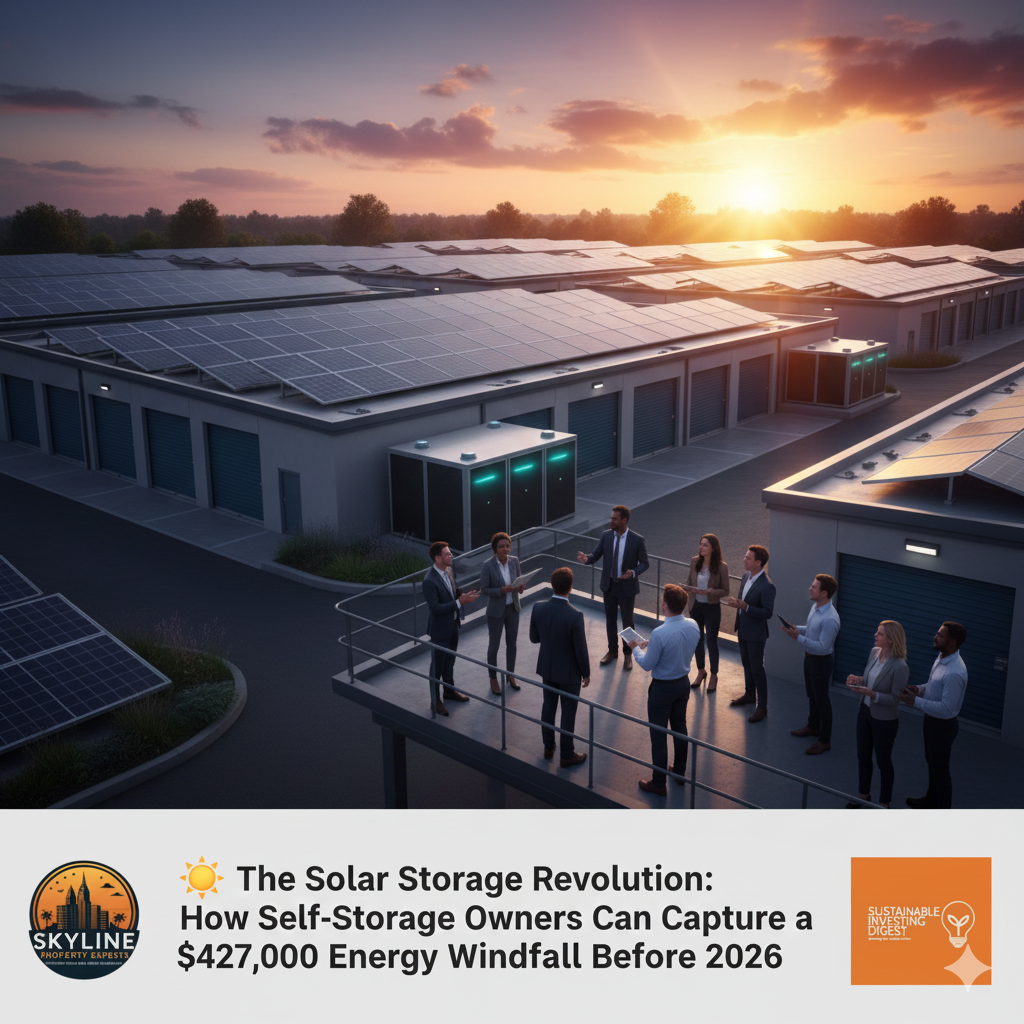
🌞 The Solar Storage Revolution: How Self-Storage Owners Can Capture a $427,000 Energy Windfall Before 2026
Introduction: The Hidden Goldmine on Your Self-Storage Roof
Most self-storage owners walk their properties every day without ever noticing the quietest, most profitable opportunity sitting right above their heads. It doesn’t complain. It doesn’t break. It doesn’t demand employee training, software upgrades, or marketing dollars. It just sits there—an enormous, perfectly open, perfectly unused rooftop that could be generating hundreds of thousands of dollars. And yet, across the country, billions of square feet of metal and flat membrane roofing go to waste every year while utility bills soar at double-digit inflation.
But a shift is happening—quietly, but quickly. Smart operators, early adopters, and institutional buyers are already taking advantage of what may be the most high-impact return-on-investment opportunity available in commercial real estate today: solar power. Not because it’s “green.” Not because it’s trendy. But because it makes financial sense on a level that most operators still underestimate. Solar is no longer a nice-to-have—the economics have matured into a necessity. Owners who install solar see NOI rise, valuations jump, expenses collapse, and buyers line up.
As Jigar Shah famously said, “The great opportunities are not seen with the eyes—they’re felt first by those bold enough to act.” The bold operators in self-storage are not waiting for the perfect moment. They’re recognizing that the perfect moment is already here—and that it won’t last much longer.
This article breaks down the numbers, the case studies, the tax incentives, the 195% return-on-investment opportunity, and the simple math behind why the next 18–24 months may be the most profitable solar window self-storage will ever see. And once that window closes? Owners who miss it will be forced to compete with facilities generating their own power at a fraction of the cost.
The goldmine is on your roof. The only question is whether you’ll be the one to claim it.
The 2026 Solar Cliff: Why Timing Is Everything
If you’ve ever regretted missing out on a major investment wave—opportunity zones, early 2020s rate arbitrage, or compressed cap-rate exits—then consider this your early-warning signal: solar is approaching its own “last call.” For years, the federal Investment Tax Credit (ITC) made solar adoption almost embarrassingly affordable. A full 30% of your system cost came right off your tax bill. No games. No complicated paperwork. But starting January 2026, that number drops from 30% to 26%. And the following year, it slides again to 22%. That may sound small, but for a typical $600,000 system, that’s a six-figure swing. Whether that swing lands in your pocket or disappears forever depends entirely on when you act.
But here’s the twist—the ITC isn’t dropping alone. Equipment prices are rising due to supply chain pressure, tariff expansion, raw material shortages, and exploding global demand. Panels that cost $0.31 per watt last year are forecast to hit $0.38–$0.42 by 2026. Inverters and racking? Up 15–25%. Skilled labor? Already up 10% in many markets. Every year you wait, your installation cost climbs while your tax incentive shrinks.
Meanwhile, utility rates continue to spike. In Florida alone, electric rates are up over 22% since 2022, and regulatory filings show no expectation of that trend slowing. Politically, economically, and structurally, utility companies have no incentive to keep rates low—and massive incentive to keep raising them. For self-storage operators, that means every month of delay is effectively a lost opportunity, because the economics of solar reward early adopters more than any other group.
In short: the ITC is dropping, equipment is getting pricier, and utilities are getting more expensive. There will be a moment—likely in 2026—when the math simply won’t be as attractive as it is today. The question is… will you capture the advantage while it’s still on the table?
Why Solar is Transforming Self-Storage Economics
Ask a self-storage owner what their biggest concerns are, and you’ll hear the same list almost every time: property taxes, insurance premiums, payroll costs, and utility bills. Three of those are unpredictable. One of them—electricity—is now 100% controllable. That’s why institutional owners, REITs, and private equity groups are moving aggressively into solar: because solar isn’t just an energy decision. It’s a financial strategy.
Self-storage isn’t an energy-intensive business, but it’s an energy-dependent business. Climate-controlled units require 24/7 cooling and humidity management. Security systems, access gates, cameras, lighting, and office operations run day and night. Once utility rates rise—and they always do—your NOI suffers. But with solar, you’re buying a fixed-cost energy asset that produces predictable, inflation-proof power for 25+ years. In other words, you’re replacing an expense with an investment.
Here’s the secret institutional buyers already understand: every $1 saved in expenses increases asset value by $16–$20 at typical cap rates. That means a $60,000 annual energy reduction could increase your property value by over $1 million. This kind of direct NOI-to-valuation leverage is extremely rare in real estate—and self-storage is uniquely positioned to capitalize on it because of its massive roof space relative to its energy load.
Solar isn’t an economic add-on. It’s an NOI accelerator. And in a world where interest rates are higher, buyers are conservative, and margins are thinner, the operators who control their expenses are the ones who win.
Case Study 1: 150,000 SF Tampa Facility
When investors ask whether solar actually moves the needle in real-world operations, this Tampa case study is the one that stops the conversation. Before solar was installed, this 150,000-square-foot facility was paying roughly $84,000 per year in electricity costs—an amount that was increasing between 8% and 12% annually depending on seasonal loads and utility rate changes. Over a five-year period, the projected energy cost was $462,000, and every one of those dollars was a direct hit to NOI. No appreciation. No tax benefit. Pure overhead.
But once the ownership group installed a 250 kW rooftop solar system, everything changed. The installation cost came in at about $625,000, which is standard for a facility of this size. Under the 30% Investment Tax Credit, the owner immediately captured a $187,500 federal tax credit, dropping the true cost to $437,500. From day one, the system began offsetting approximately 80% of the facility’s total energy load, slashing annual utility expenses from $84,000 to $16,800. That alone produced a five-year savings of $335,600, not counting utility inflation, which would make the savings even higher.
By Year 6, the system had essentially paid for itself, and every year after that, the owner enjoyed $67,000+ in pure annual profit for the remaining life of the panels—typically 25 to 30 years. The long-term impact is staggering: over the system’s lifespan, the owner is expected to save more than $1.5 million in reduced utilities. And at a 6% cap rate, the immediate increase in property value from the NOI bump alone is more than $1.1 million.
This single project demonstrates why solar is becoming a core part of investment strategy—not an optional enhancement. When a rooftop can create over a million dollars of value without increasing rent, adding tenants, or expanding the building, operators simply cannot afford to ignore it. And with ITC incentives dropping, anyone waiting for a better time to install solar will likely find that the best time was yesterday.
Case Study 2: Polk County 67,000 SF Facility
If the Tampa example demonstrates solar’s massive scale potential, the Polk County case study proves that high ROI isn’t limited to large facilities. This 67,000-square-foot, Class B property was acquired for $4.2 million at a 7.8% cap rate, making it a solid but unspectacular investment on paper. The facility had stable occupancy, reasonable operating expenses, and typical utility costs for a climate-controlled, security-focused storage operation. Nothing extraordinary—until the new owners evaluated the roof for solar potential.
The preliminary analysis revealed that the facility could support a system generating enough energy to cut approximately $38,400 per year in operating expenses. After receiving competitive bids from vetted installers, the final installation cost came to $310,000, which dropped to $217,000 after applying the 30% federal ITC. With annual savings of $38,400, the investment produced a simple payback period of just over 5.6 years—significantly faster than many commercial real estate improvements.
But the true value was in the asset-level math. At a 6% exit cap—commonly used by institutional buyers for solar-enhanced assets—the NOI increase translated into an immediate $640,000 boost in property value. That means the owner effectively turned a $217,000 net solar investment into a $423,000 gain, representing an extraordinary 195% return before factoring in additional utility savings or energy inflation.
What makes this case especially important is that it shows solar isn’t just for trophy facilities or large developers. Even midsize or Class B/C assets in secondary markets can unlock institutional-level returns with the right solar installation—and often with minimal permitting issues, thanks to their large, unobstructed roof spans.
For operators buying or refinancing smaller assets, this type of value creation can dramatically shift their long-term investment strategy. Solar can push an asset into a lower cap-rate tier, attract stronger buyers, reduce debt-service pressure, and stabilize cash flow during economic downturns. In Polk County, solar didn’t just cut expenses—it redefined the property’s trajectory, and it’s a blueprint owners everywhere can replicate.
The Triple Value Creation Framework
Solar is not a single-benefit improvement. It’s a triple-threat value engine that strengthens a self-storage facility in three separate and compounding ways. Understanding this framework helps investors appreciate why solar is becoming a competitive advantage—and why early adopters are the ones seeing the biggest returns.
- The NOI Explosion
Every dollar saved in expense reduction is equivalent to $16–$20 in property value at typical storage cap rates. Solar’s ability to cut 70–90% of electricity costs creates an immediate and ongoing increase in NOI—one that compounds annually as utility rates rise. In many cases, solar increases net operating income by $30,000 to $80,000 per year without adding a single tenant. Unlike rent increases or expansions, these savings aren’t dependent on market demand, competition, or economic cycles. They’re locked in. Predictable. Bulletproof. - Institutional Appeal
REITs and private equity buyers are aggressively pursuing solar-ready or solar-equipped storage properties. They recognize the long-term stability, lower risk profile, and operational efficiency solar provides. As a result, solar-equipped facilities routinely trade at premium cap rates, often 25–75 basis points lower than comparable non-solar assets. For owners planning an exit in the next 3–7 years, solar can become the single most cost-effective strategy to raise valuation and expand the buyer pool. - Tenant-Driven Revenue Premiums
More owners are discovering that solar installations offer marketing advantages. RV and boat storage with solar-powered charging is commanding 15–18% higher rental rates. Climate-controlled units powered partly by renewable energy are increasingly appealing to eco-conscious consumers. And in competitive markets, sustainability can be the differentiator that drives occupancy and keeps tenants loyal.
Together, these three value streams—NOI growth, valuation premiums, and revenue differentiation—form a compounding ROI engine unmatched by any other storage upgrade. And unlike expansions, solar projects don’t require rezoning, variances, or lengthy approvals. Just sunlight, a roof, and a willingness to invest in the future.
Why Self-Storage Roofs Are Perfect for Solar
Self-storage facilities have a structural advantage that most commercial real estate assets simply cannot match: enormous, flat, unobstructed roof space. While office buildings contend with HVAC units, retail centers battle parapets and shading, and industrial properties often need their roofs clear for mechanical systems, self-storage has the clean, wide-open canvas solar installers dream of. This means lower installation costs, fewer engineering complications, faster permitting, and far more efficient system layouts. In other words, your asset type gives you a built-in economic advantage before a single panel is installed.
Self-storage also benefits from an ideal power profile. Unlike many high-load commercial buildings, storage facilities do not require heavy machinery, industrial equipment, or massive HVAC systems. Their energy use is steady, predictable, and peaks during daylight—exactly when solar produces the most. Climate-controlled units run around the clock, but their highest demands naturally align with daytime cooling loads. This synchronicity increases the percentage of power that can be directly consumed on-site, reducing reliance on net metering and improving system ROI.
Another unique benefit is roof age and replacement cycles. Many storage roofs—especially metal—have lifespans of 30–40 years, often outlasting solar panels. This minimizes the risk of having to remove and reinstall panels prematurely. And even when reroofing is needed, solar-ready mounting systems and modern racking make panel removal far less costly than owners expect. For newer facilities—or those undergoing capital improvements—solar can even be designed into the reroofing plan for maximum efficiency.
On top of all that, insurance and lender acceptance for rooftop solar is stronger in the self-storage sector than in many other CRE categories. Carriers understand the risk profile and favor the lack of foot traffic, fire load, and structural complexity. Lenders increasingly see solar as a value enhancer rather than a risk factor, making financing smoother and often cheaper.
When you combine all these advantages—large roofs, predictable energy loads, efficient installation, insurance compatibility, and strong lender appetite—you arrive at an asset class uniquely positioned to extract maximum value from solar. Self-storage isn’t just a good match for solar. It is arguably the best match in all of commercial real estate.
Operational Alpha: The Hidden Advantage
When operators talk about “alpha,” they’re often referring to outperforming market comps through rate management, occupancy strategy, or superior customer experience. But these forms of alpha depend heavily on competition and local demand. Solar introduces a completely different type of advantage—operational alpha—which is independent of market cycles, interest rates, or tenant behavior.
Solar allows owners to stabilize a major operating expense for decades. In an industry where margins depend heavily on predictable outflows, locking in a 25-year energy cost is a strategic win that compounds over time. With utilities climbing year after year, operators without solar face an unavoidable rise in expenses that eats directly into NOI. Solar owners don’t. Their energy cost curve flattens while competitors’ curves continue rising. Over a 10-year period, this difference becomes enormous—even before factoring in tax benefits.
Operational alpha also comes from reduced vulnerability to grid fluctuations. Many regions across the U.S. are experiencing grid instability, seasonal rate spikes, and even rolling outages. While solar doesn’t replace grid power entirely, it does reduce dependence during peak pricing hours and increases resilience during outages. For facilities with automatic gates, climate controls, and electronic access systems, even brief outages can disrupt operations and frustrate tenants. Solar smooths out these operational risks.
Another form of alpha comes from marketing. Consumers—especially millennials and Gen Z—are increasingly favoring sustainable businesses. Solar gives owners a tangible, marketable, highly visible sustainability feature that is easy to communicate:
“This facility is powered by clean energy.”
It’s simple, powerful, and emotionally resonant.
Solar also provides operational alpha by extending equipment life. When your facility draws part of its power load from solar, it reduces strain on HVAC systems by lowering peak demand levels. Lower peak demand means less thermal stress on compressors, fewer emergency repairs, and longer lifespans for your most expensive equipment.
Put all of this together, and solar doesn’t just produce energy—it produces stability, resilience, and efficiency. Operational alpha is the advantage that keeps paying owners back long after the system itself has been fully paid off.
How Utility Inflation Increases Solar ROI Automatically
One of the most misunderstood aspects of solar economics is how aggressively rising utility prices amplify solar ROI automatically year after year—without any action from the owner. The simple truth is that solar’s performance doesn’t depend on where utility rates are today. It depends on where they’ll be over the next 25 years. And history is clear: utility prices move in only one direction.
Across the U.S., electricity rates have risen an average of 2.5% to 4% annually for decades. In Florida, the trend has accelerated, with increases of 22% since 2022 driven by natural gas pricing, grid modernization, regulatory adjustments, and fuel hedging costs. Energy experts project that Florida utilities could increase rates an additional 15–20% over the next few years. These increases hit storage operators with no alternative options—unless they adopt solar.
Here’s the magic: every dollar your solar system saves today becomes $1.05, $1.10, $1.20, or more in future years simply because utility rates go up. Solar produces the same power output annually, but the value of that energy increases automatically as utility prices rise. It’s like buying a bond whose coupon increases every year—but with no additional investment required.
This automatic inflation hedge is the real reason solar is such a powerful investment for self-storage. Without solar, rising utilities squeeze your margins. With solar, rising utilities increase your profits. This inversion of risk is rare in commercial real estate. Instead of being exposed to inflation, solar owners become beneficiaries of it.
Solar doesn’t just save money. It protects you from an unpredictable future—and turns inflation into an ally rather than an adversary.
The Strategic Advantage Over Competitors
As more operators adopt solar, a competitive divide is emerging—a divide similar to what happened when early adopters embraced climate control, online rentals, or automated gates. Suddenly, their assets were more attractive, more efficient, and more profitable. Solar is becoming that next dividing line.
Facilities with solar achieve lower operating expenses, stronger margins, and higher valuations. They can weather rate wars, inflation cycles, and utility volatility more comfortably than competitors. And during acquisition seasons, solar-equipped facilities stand out immediately. Buyers recognize them as lower-risk, higher-yield assets with built-in cost protection for decades.
REITs, in particular, place enormous value on operational efficiency and predictability. When they see a property with a fully engineered, warrantied solar system delivering consistent energy savings, they adjust their valuations accordingly. Solar-equipped facilities regularly capture premium cap rates compared to similar non-solar assets.
In competitive markets, solar becomes the edge. Owners who embrace it early will define the market standard. Owners who delay may eventually be forced to adopt solar just to stay competitive—but by then, incentives will be smaller, costs will be higher, and the early-mover advantage will be gone.
Solar is no longer just an energy strategy. It is a competitive moat.
Financing Options for Owners
One of the most common misconceptions about solar is that you must pay for it upfront. In reality, self-storage owners have multiple financing structures available—each with its own advantages.
Cash Purchase:
This offers the highest ROI and the fastest payback. Owners capture 100% of the federal tax credit, all depreciation benefits, and the full value of utility savings. For estates or long-term hold strategies, cash purchase is the strongest wealth-building approach.
Solar Loans:
These provide full ownership with minimal upfront capital. Loan payments are often offset by the facility’s reduced utility bills. Once the loan is paid off, savings and profits skyrocket. Storage facilities with stable NOI typically qualify for favorable terms.
Power Purchase Agreements (PPAs):
A third party installs and owns the system, and the operator buys discounted solar energy at a fixed rate. There’s no upfront cost, and operators benefit from immediate energy savings. This is ideal for owners with limited tax appetite or those preparing for a near-term sale.
Solar Leases:
Similar to PPAs but structured as a lease payment instead of energy purchase. Leases offer predictable, stable costs and are excellent for risk-averse owners who don’t want maintenance responsibilities.
Each option leads to NOI improvements and long-term savings—but the optimal choice depends on the owner’s tax position, investment horizon, and cash flow strategy. Skyline Property Experts specializes in helping owners evaluate these structures to maximize ROI while minimizing financial friction.
Installer Vetting Checklist
Choosing the right installer is crucial. A solar system is a 25- to 30-year asset, and the wrong installer can compromise performance, warranties, safety, and long-term value. Every owner should vet installers using a strict professional checklist.
Certifications:
Look for NABCEP-certified installers—the gold standard in the U.S. solar industry. Certification ensures expertise, safety training, and industry best practices.
Component Quality:
Panels should come from Tier 1 manufacturers with strong financial backing. Inverters should be from reputable brands with 10–15-year warranties. Racking systems must be engineered for your roof type.
Warranty Coverage:
Ensure you have three layers of protection: manufacturer warranties, workmanship warranties, and production guarantees. High-quality installers provide long-term coverage that matches the lifespan of your asset.
Roof Compatibility:
Installers must understand your roof’s age, material, and structural load. Self-storage roofs are often ideal for solar, but engineering must be precise.
Production Modeling:
Installers should provide detailed energy modeling using tools like Helioscope or Aurora Solar. Avoid any installer that can’t provide detailed projections.
References and Track Record:
Ask for commercial references—preferably self-storage or industrial customers. Experience matters.
This vetting process protects your investment and ensures your solar system becomes a true NOI engine—not a future headache.
The Role of Skyline Property Experts
Skyline Property Experts doesn’t merely recommend solar—they help owners execute it. With years of CRE experience and a deep understanding of self-storage operations, they’ve built a service platform specifically tailored to the needs of storage investors.
Free Feasibility Analysis:
For qualifying facilities, Skyline provides a full solar feasibility report at no cost. This includes financial modeling, energy offset projections, tax incentive breakdowns, and ROI estimates.
Installer Vetting:
They maintain a network of vetted solar installers who specialize in commercial and self-storage installations. Owners receive 3–5 competitive bids, saving time and avoiding costly mistakes.
Financing Navigation:
Whether you prefer cash purchase, loans, PPAs, or leases, Skyline helps structure the optimal financing approach to maximize returns.
Off-Market Solar-Ready Deals:
Skyline has access to REO and off-market storage properties with ideal solar characteristics, giving investors a competitive edge.
End-to-End Guidance:
From interconnection applications to tax credit documentation, they guide owners every step of the way to ensure smooth implementation and maximum ROI.
Skyline understands that solar isn’t about panels—it’s about profits, value creation, and strategic advantage.
The Bigger Picture: Solar and Sustainable Investing
Solar is not just an investment—it’s a shift in how commercial real estate responds to the evolving demands of markets, investors, and communities. Sustainable investing has moved from a values-driven niche to a mainstream financial strategy. Institutional capital increasingly prioritizes environmental resilience, operational efficiency, and energy independence. Storage owners who adopt solar are aligning their assets with long-term global trends while capturing immediate financial benefits.
Investors are realizing that sustainability isn’t a cost—it’s a competitive asset. Solar reduces risk, enhances resilience, strengthens cash flow, and positions facilities for premium exits. In a world where capital seeks stability, solar-equipped properties stand out as future-proof assets with built-in inflation hedges and predictable energy systems.
Sustainable Investing Digest exists to empower investors with these insights—showing how clean energy intersects with cash flow, asset value, and long-term wealth creation. Solar is not the future. It is the present—and the most lucrative window is closing fast.
Conclusion: The Window Is Closing—And Only Two Types of Owners Will Exist
When the 2026 ITC reductions arrive and solar equipment costs continue rising, the self-storage landscape will divide into two categories: owners who capitalized on the solar opportunity when the economics were at their peak, and owners who waited—only to face higher expenses, lower margins, and a competitive disadvantage they can never fully recover from.
The operators who act now will enjoy decades of higher NOI, stronger exit values, more resilient operations, and a brand reputation built on innovation and sustainability. Those who delay will watch their competitors operate leaner, sell higher, and attract premium tenants while they continue paying soaring utility bills.
The opportunity is now. The returns are real. The economics are proven.
For uninterrupted NOI growth, long-term inflation protection, and outsized valuation gains, solar is the strongest investment self-storage owners can make before 2026.
Subscribe to Sustainable Investing Digest to stay ahead of the most important trends in real estate, renewable energy, and long-term asset value creation.
Visit SkylinePropertyExperts.com to request your free solar feasibility analysis and unlock your facility’s full potential.
FAQs
- Is solar really worth it for smaller storage facilities?
Yes. Even 20,000–40,000 SF facilities often see 5–7-year paybacks and six-figure valuation increases. - Do solar panels damage metal roofs?
No. When installed correctly with proper racking systems, metal roofs are ideal for solar and often require no penetrations. - What if I plan to sell my facility soon?
Solar increases valuation and attracts institutional buyers who prefer sustainable, low-cost assets. - Does solar work for facilities without climate control?
Absolutely. Lighting, gates, cameras, and office loads still create substantial savings. - Can solar help me during a power outage?
While standard systems shut down during outages, battery add-ons can provide backup power for gates and security systems.
📬 Weekly Green Alpha Strategies:
- Subscribe to Sustainable Investing Digest: Subscribe on LinkedIn https://www.linkedin.com/build-relation/newsletter-follow?entityUrn=7053058780464345088
- Subscribe to Global Empowerment Leadership: Subscribe on LinkedIn https://www.linkedin.com/build-relation/newsletter-follow?entityUrn=7060440518475804672
📞 Get Your Free Solar Feasibility Analysis:
- Skyline Property Experts | 786-676-4937 | www.skylinepropertyexperts.com
- Capital Advisors USA | First analysis complimentary for facilities >40,000 SF
💬 Your Turn: Have you installed solar on your CRE assets? What was your ROI? Drop your experience below! 👇
#SolarSelfStorage #RenewableEnergy #SustainableInvesting #SolarROI #SelfStorageInvesting #FloridaCRE #GreenRealEstate #ITC2026 #EnergyIndependence #SkylinePropertyExperts #CapitalAdvisorsUSA #SustainableInvestingDigest #GlobalEmpowermentLeadership
Please don’t forget to leave a review.
Explore more by joining me on Linkedin.