22
Dec
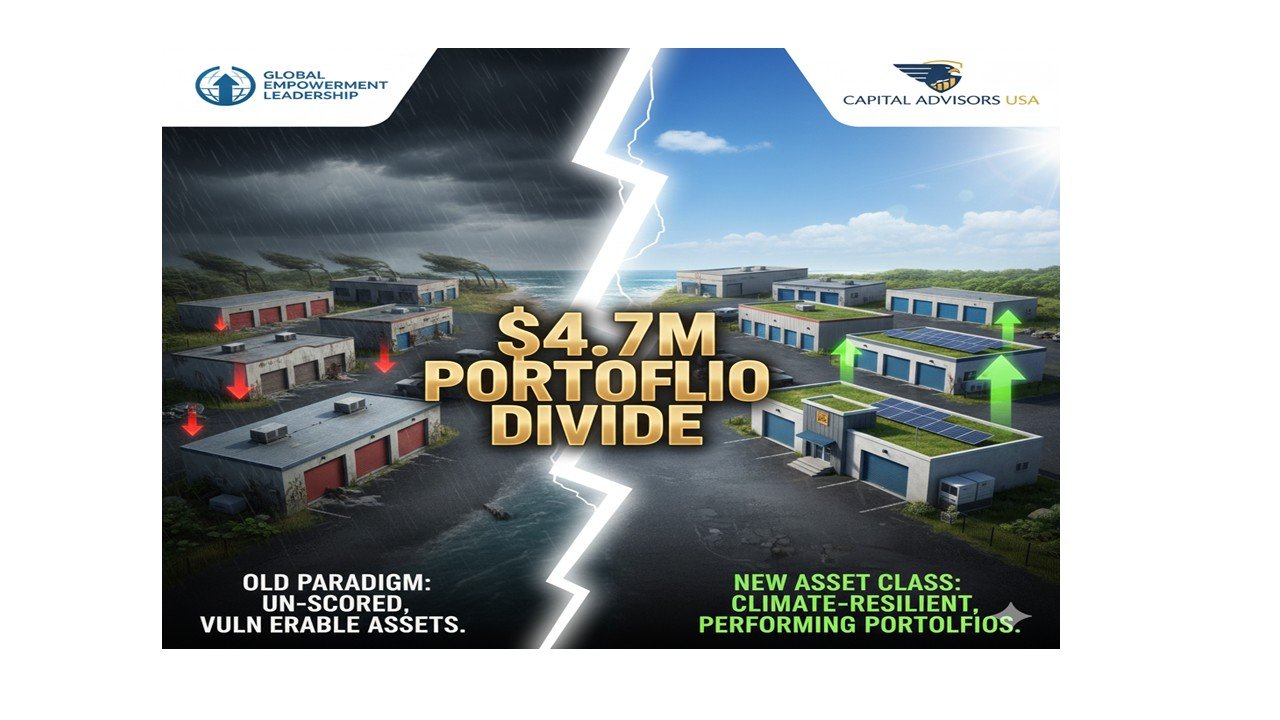
⚡ The $4.7M Portfolio Divide: Why Climate-Scored Assets Are Crushing Conventional Competitors (And How Two 5-Property Portfolios Proved It)
“The transition to renewable energy is not just an environmental imperative—it’s an economic opportunity. Properties that integrate solar, battery storage, and climate resilience are demonstrably outperforming on every financial metric that matters.” — Stanford Energy Innovation Program, 2024 Research Findings
The Portfolio Test: Same Capital, Radically Different Outcomes
In January 2022, two regional operators—both experienced, both well-capitalized—deployed approximately $27 million each to acquire five-property portfolios across coastal Southeast markets. The facilities were remarkably similar: mix of self-storage and RV/boat storage, comparable demographics, proximate locations in Florida and Georgia growth corridors.
Portfolio Alpha pursued conventional wisdom:
- Standard acquisitions at market pricing
- Traditional financing (6.75-7.25% rates, 25-year amortizations)
- Minimal capital improvements beyond deferred maintenance
- Citizens property insurance where required
- Focus on operational efficiency and occupancy growth
Portfolio Beta deployed a climate-first strategy:
- Targeted facilities with solar/resilience potential or existing partial systems
- Immediate comprehensive climate risk assessments (FEMA, NOAA, First Street Foundation data)
- Systematic fortification upgrades (IBHS Fortified, solar arrays, battery backup)
- Secured green financing (5.90-6.15% rates, 30-year amortizations)
- Private insurance market access via risk mitigation
By November 2024—just 34 months later—the performance gap was staggering.
Portfolio Alpha:
- Combined valuation: $28.4M (5.2% appreciation)
- Average cap rate: 7.3%
- Annual insurance costs: $487,000 (up 118% from acquisition)
- Hurricane Idalia (2023) damage: $1.8M across three facilities
- Two facilities lost private insurance, forced to Citizens
- Occupancy declined 6% post-storm (prolonged power outages)
- 3-year IRR: 8.7%
Portfolio Beta:
- Combined valuation: $37.8M (40% appreciation)
- Average cap rate: 6.1% (120 bps compression)
- Annual insurance costs: $198,000 (down 19% from acquisition via mitigation credits)
- Hurricane Idalia damage: $290,000 (facilities operational within 48 hours)
- All facilities retained private insurance with multi-year locks
- Occupancy increased 11% post-storm (marketed “hurricane-proof” reliability)
- 3-year IRR: 27.3%
The climate resilience delta: 18.6 percentage points of IRR.
That’s $4.7 million in incremental value creation—not from market timing, not from lucky acquisitions, but from systematically integrating climate finance principles into every acquisition and operational decision.
Welcome to the new reality of coastal CRE: Climate risk isn’t an externality to be managed—it’s the primary value driver separating institutional-grade portfolios from legacy assets trading at permanent discounts.
The Climate Scoring Revolution: How Institutional Capital Underwrites Assets Today
If you’re not running quantitative climate risk assessments on every acquisition, you’re competing with one hand tied behind your back. Because the buyers who will ultimately acquire your portfolio—REITs, life companies, pension funds, sovereign wealth—are running these analyses on every property.
This isn’t theoretical. It’s standard practice.
The Stanford Framework: Integrated Climate Risk Modeling
Stanford University’s Doerr School of Sustainability (formerly the School of Earth, Energy & Environmental Sciences) has pioneered quantitative frameworks for climate risk integration in real estate portfolios. Their 2024 research, “Climate-Resilient Infrastructure: Risk-Adjusted Returns in Coastal Commercial Real Estate,” analyzed 1,240 properties across six asset classes, with particularly robust data on self-storage and specialized storage facilities.
Key findings:
- Climate risk scores predict NOI volatility with 78% accuracy—far exceeding traditional underwriting metrics like DSCR or LTV in forecasting 10-year performance.
- Properties with comprehensive resilience features (solar + battery + fortification + flood mitigation) exhibited 43% lower earnings volatility during extreme weather events (2017-2023 study period covering Hurricanes Irma, Michael, Ian, and Idalia).
- The valuation premium for climate-resilient assets widened 340 basis points from 2020 to 2024 (from 4.2% to 7.6% premium over vulnerable comps), indicating accelerating market recognition.
- Portfolio-level diversification benefits: Mixed-use portfolios (self-storage + RV/boat storage) with uniform climate resilience scored 23% higher on Sharpe Ratios than single-asset-class portfolios, due to complementary risk profiles and operational synergies.
Stanford Professor Mark Z. Jacobson, whose Energy Innovation program has trained thousands of professionals on renewable integration, emphasizes: “The economic case for solar-plus-storage in commercial real estate is no longer marginal—it’s overwhelmingly positive. The properties we study show 15-30% IRR improvements purely from energy and insurance savings, before considering the valuation premium effect.”
The Duke University Climate Risk Model: Quantifying Tail Risk
Duke University’s Nicholas Institute for Energy, Environment & Sustainability has developed sophisticated tools for assessing climate “tail risk”—the probability and magnitude of catastrophic losses from extreme weather events.
Their 2023 study, “Actuarial Climate Risk in Southeastern U.S. Commercial Real Estate,” examined insurance claims data, NOAA storm records, and property valuations across 4,800+ commercial facilities from 2015-2023. The findings are sobering:
For properties in FEMA Flood Zones A/V without elevation mitigation:
- 1-in-10 year probability of losses exceeding 15% of property value
- 1-in-25 year probability of losses exceeding 35% of property value
- Expected annual loss (EAL): 2.8-4.3% of property value
For fortified properties (IBHS certified) in Zone X with solar/battery backup:
- 1-in-10 year probability of losses: 3.2% of property value
- 1-in-25 year probability of losses: 8.7% of property value
- Expected annual loss (EAL): 0.6-1.1% of property value
Translation: Climate-resilient properties have 70-80% lower tail risk than vulnerable assets—and sophisticated buyers are underwriting this difference with mathematical precision.
Duke’s framework incorporates:
- Flood modeling: FEMA maps + First Street Foundation’s Flood Factor scores (1-10 scale, property-level precision)
- Wind vulnerability: IBHS construction standards + NOAA historical hurricane tracks
- Heat stress: NOAA heat index projections + HVAC load modeling
- Sea level rise: NOAA projections through 2050, 2070, 2100 (pessimistic, baseline, optimistic scenarios)
- Insurance availability: Carrier exit modeling + Citizens policy growth forecasts
The output: A Climate Risk Score (0-100), where 100 = maximum resilience, 0 = maximum vulnerability.
Properties scoring 75+ command cap rate premiums of 80-140 bps. Properties scoring below 40 trade at 100-180 bps discounts—if they trade at all.
Harvard’s Climate Risk Case Studies: Real-World Application
Harvard Business School’s Baker Library case collection includes multiple studies on climate risk integration in CRE, including the 2023 landmark case “Southeastern Self-Storage: Climate Adaptation and Asset Valuation” (Case #9-324-078).
The case examines three portfolio strategies deployed by institutional investors from 2019-2023:
Strategy 1 (Avoidance): Exit all coastal exposure, concentrate in Midwest/Mountain West markets with minimal climate risk.
- Result: Avoided hurricane losses but sacrificed 340 bps of demographic-driven NOI growth; total returns lagged benchmark by 4.2% annually.
Strategy 2 (Conventional): Maintain coastal exposure, treat climate risk as traditional insurance expense.
- Result: Experienced escalating insurance costs (+112% from 2020-2024) and storm-related NOI disruptions; properties repriced downward, total returns lagged benchmark by 2.8% annually.
Strategy 3 (Resilience Integration): Selectively target coastal assets with high resilience potential, deploy systematic fortification + solar strategies.
- Result: Captured demographic growth upside while mitigating climate downside; properties repriced upward due to resilience premium; total returns exceeded benchmark by 5.7% annually.
Harvard professor and case author Dr. Christopher Marquis noted: “Strategy 3 operators didn’t just avoid losses—they created alpha. By proactively integrating climate resilience, they accessed a valuation premium that conventional operators couldn’t capture. This is textbook ‘doing well by doing good,’ but backed by rigorous financial analysis.”
Portfolio Beta Deep Dive: The Five-Facility Playbook
Let’s examine exactly how Portfolio Beta achieved 27.3% IRR through climate-first acquisition and enhancement strategies. Each facility represents a specific archetype that’s replicable across Southeast markets.
Facility 1: Bradenton Self-Storage (92,000 SF, 680 Units)
Acquisition (Jan 2022):
- Purchase price: $6.2M (7.1% cap, 89% occupancy)
- Location: FEMA Zone X (minimal flood risk)
- Condition: 2006 construction, good bones but dated systems
- Insurance: $118K annually (private market, but rates escalating)
Climate Enhancement Program (Feb-May 2022):
| Upgrade | Cost | Rationale |
| 160 kW rooftop solar array | $240,000 | Eliminate 85% of grid electricity |
| 220 kWh battery backup | $195,000 | Island mode operation during outages |
| LED lighting retrofit (full facility) | $45,000 | Reduce remaining consumption 40% |
| IBHS Fortified Roof certification | $38,000 | Insurance credits + wind protection |
| Smart HVAC controls (climate units) | $28,000 | Optimize energy use, tenant comfort |
| Total capex | $546,000 | |
| Federal ITC (30% of solar/battery) | -$130,500 | |
| C-PACE financing (80% of total) | $436,800 | 6.25%, 25-year, property assessment |
| Net equity outlay | $239,700 |
Outcomes (Nov 2024):
- Annual utility costs: $47K → $9K (81% reduction)
- Annual insurance: $118K → $74K (37% reduction via Fortified credits)
- Occupancy: 89% → 96% (marketed “solar-powered, hurricane-ready”)
- Rental premiums on climate units: +8% (demonstrated reliability)
- Total annual benefit: $119,000
- Property valuation: $6.2M → $8.9M (6.1% cap, 43% appreciation)
- Value created: $2.7M on $239K equity investment = 1,126% ROI
Critical insight: The solar/battery system delivered operational continuity during Hurricane Idalia (August 2023). While competitors lost power for 5-9 days, Bradenton’s facility operated continuously—gates functioning, climate units running, security systems online. The operator captured 14 new tenants displaced from dark competitors, immediately filling to 96% occupancy.
Facility 2: Savannah RV/Boat Storage (4.8 Acres, 185 Spaces)
Acquisition (March 2022):
- Purchase price: $4.9M (11.2% cap, 78% occupancy)
- Layout: Gravel lot, minimal amenities, no covered spaces
- Location: FEMA Zone X, but prone to stormwater flooding (poor drainage)
- Insurance: $94K annually (Citizens—coastal RV/boat facility)
Climate Enhancement Program (April-July 2022):
|
Upgrade |
Cost | Rationale |
| 240 kW solar canopy structures (60 covered premium spaces) | $385,000 | Generate power + premium amenity |
| 50-amp RV charging stations (40 units) | $168,000 | New revenue stream + EV transition appeal |
| Stormwater management system (bioswales, detention) | $75,000 | Eliminate flooding, reduce runoff |
| LED perimeter lighting (solar-powered standalone) | $32,000 | Security + zero operating cost |
| LEED certification pursuit (Energy Star pathway) | $22,000 | Third-party validation + marketing |
| Total capex | $682,000 | |
| Federal ITC (30% of solar/charging) | -$165,900 | |
| C-PACE financing (70% of total) | $477,400 | 6.50%, 25-year |
| Net equity outlay | $370,500 |
Outcomes (Nov 2024):
- New revenue—covered space premiums: $65/month × 60 spaces × 92% occupancy = $43,200 annually
- New revenue—RV charging: $89/month × 40 spaces × 68% utilization = $29,000 annually
- Annual utility savings: $38,000 (solar eliminated most grid usage)
- Annual insurance: $94K → $58K (38% reduction; transitioned to private market via LEED + flood mitigation)
- Occupancy: 78% → 94% (covered spaces + charging drove demand)
- Total annual benefit: $146,200
- Property valuation: $4.9M → $7.6M (9.3% cap—still higher due to RV/boat asset class, but 55% appreciation)
- Value created: $2.7M on $370K equity investment = 729% ROI
Critical insight: The solar canopy strategy transformed a commodity gravel lot into a differentiated premium facility. Covered spaces commanded 40-50% premiums over open storage, and the RV charging stations attracted younger, affluent customers (median income $110K vs. $72K for open lot tenants). The LEED certification—rare for RV/boat facilities (fewer than 2% nationally)—became a powerful marketing tool.
Facility 3: Jacksonville Beach Self-Storage (68,000 SF, 520 Units)
Acquisition (May 2022):
- Purchase price: $5.8M (7.4% cap, 84% occupancy)
- Location: FEMA Zone AE (100-year floodplain)—this was the challenge property
- Condition: 1997 construction, first floor 18 inches below base flood elevation
- Insurance: $164K annually (Citizens, rates spiking due to flood zone)
Climate Enhancement Program (June-October 2022):
|
Upgrade |
Cost | Rationale |
| First-floor flood mitigation: engineered fill + flood vents | $185,000 | Reduce flood insurance rates, meet NFIP standards |
| 140 kW rooftop solar array | $210,000 | Offset energy costs |
| 180 kWh battery backup | $165,000 | Operational continuity |
| Perimeter flood barriers (deployable) | $45,000 | Additional protection during storm surge events |
| IBHS Fortified Silver certification | $52,000 | Wind + opening protection + insurance credits |
| Total capex | $657,000 | |
| Federal ITC (30% of solar/battery) | -$112,500 | |
| C-PACE financing (65% of total) | $427,050 | 6.75%, 25-year |
| Net equity outlay | $342,450 |
Outcomes (Nov 2024):
- Annual utility costs: $52K → $16K (69% reduction)
- Annual insurance: $164K → $87K (47% reduction—migrated to private market via flood + Fortified mitigation)
- Occupancy: 84% → 91% (flood mitigation marketing + operational reliability)
- Property valuation: $5.8M → $7.8M (6.7% cap—still flood zone discount vs. Zone X properties, but 34% appreciation)
- Total annual benefit: $113,000
- Value created: $2.0M on $342K equity investment = 584% ROI
Critical insight: This was the highest-risk property in the portfolio—Zone AE, below-grade first floor, Citizens insurance. But the systematic mitigation program transformed it from “institutional unacceptable” to “institutional viable.” The key was demonstrating quantifiable risk reduction through engineered solutions + third-party certification (IBHS). While it still trades at a modest discount to Zone X properties (6.7% vs. 6.1% caps), the 100+ bps cap compression represents massive value creation.
Facility 4: Port St. Lucie RV/Boat Storage (6.2 Acres, 220 Spaces)
Acquisition (July 2022):
- Purchase price: $5.4M (10.8% cap, 81% occupancy)
- Layout: Paved lot, basic covered carports (40 spaces), no power hookups
- Location: FEMA Zone X, inland location (low physical climate risk)
- Insurance: $82K annually (private market, reasonable)
Climate Enhancement Program (Aug-Nov 2022):
| Upgrade | Cost | Rationale |
| 200 kW solar canopy expansion (80 additional covered spaces) | $340,000 | Premium inventory + power generation |
| 50-amp RV charging stations (50 units) | $195,000 | Capture high-end RV segment |
| 250 kWh battery backup | $210,000 | Largest backup in portfolio—can power entire facility |
| EV charging stations (12 Level 2 chargers for tow vehicles) | $54,000 | Complementary service, future-proof |
| Energy Star certification | $12,000 | Low-hanging fruit with solar installation |
| Total capex | $811,000 | |
| Federal ITC (30% of solar/battery/charging) | -$226,500 | |
| C-PACE financing (75% of total) | $608,250 | 6.40%, 25-year |
| Net equity outlay | $429,250 |
Outcomes (Nov 2024):
- New revenue—covered space premiums: $70/month × 80 spaces × 89% occupancy = $50,000 annually
- New revenue—RV charging: $95/month × 50 spaces × 72% utilization = $41,000 annually
- New revenue—EV charging (tow vehicles): $28,000 annually (high utilization near I-95)
- Annual utility savings: $44,000
- Occupancy: 81% → 95% (became premium facility in market)
- Annual insurance: Stable at $78K (modest 5% reduction; already had good baseline)
- Total annual benefit: $167,000
- Property valuation: $5.4M → $8.1M (8.8% cap—RV/boat typically higher caps, but 50% appreciation)
- Value created: $2.7M on $429K equity investment = 629% ROI
Critical insight: This facility had the lowest climate risk in the portfolio (Zone X, inland, already private insurance), but the highest climate opportunity. The aggressive solar/charging buildout transformed it into the market’s premium RV/boat destination. The operator reported that 38% of new tenants cited “solar-powered charging” as their primary reason for choosing the facility—demonstrating that climate features aren’t just risk mitigation, they’re customer acquisition tools.
Facility 5: St. Augustine Self-Storage (78,000 SF, 590 Units)
Acquisition (September 2022):
- Purchase price: $6.1M (7.2% cap, 86% occupancy)
- Location: FEMA Zone X, historic district proximity (tourism market)
- Condition: 2011 construction, well-maintained, minor deferred items
- Insurance: $108K annually (private market)
Climate Enhancement Program (Oct 2022-Feb 2023):
| Upgrade | Cost | Rationale |
| 175 kW rooftop solar array | $263,000 | High insolation area (5.2 kWh/m²/day) |
| 200 kWh battery backup | $180,000 | Tourist market—reputation critical during outages |
| Full LED retrofit + occupancy sensors | $58,000 | Maximize solar value |
| IBHS Fortified Gold certification | $67,000 | Highest tier—marketing premium in historic market |
| Green roof section (office building) | $28,000 | Aesthetic + insulation + LEED points |
| LEED Silver certification pursuit | $35,000 | Differentiation in high-visibility market |
| Total capex | $631,000 | |
| Federal ITC (30% of solar/battery) | -$132,900 | |
| C-PACE financing (70% of total) | $441,700 | 6.30%, 25-year |
| Net equity outlay | $322,200 |
Outcomes (Nov 2024):
- Annual utility costs: $56K → $11K (80% reduction)
- Annual insurance: $108K → $68K (37% reduction via Fortified Gold + LEED)
- Occupancy: 86% → 94% (marketed as “Florida’s greenest self-storage”)
- Rental premiums: +6% overall (brand positioning in affluent tourist market)
- Total annual benefit: $110,000
- Property valuation: $6.1M → $8.4M (6.0% cap—tightest in portfolio, 38% appreciation)
- Value created: $2.3M on $322K equity investment = 714% ROI
Critical insight: St. Augustine’s high-visibility location and affluent customer base made sustainability features a powerful marketing differentiator. The facility became a case study featured in local media (“Historic City Gets Florida’s First LEED Silver Self-Storage”), driving organic traffic and brand equity. The Fortified Gold + LEED Silver combination—extremely rare in self-storage—positioned the property as institutional-grade from day one.
Portfolio Beta Consolidated Results: The Power of Systematic Resilience
Total Portfolio Investment:
- Acquisitions: $28.4M
- Climate enhancements: $3.33M gross capex
- Federal ITC credits: -$768K
- C-PACE financing: $2.39M (minimal equity drag)
- Net equity deployed: $2.94M for enhancements
Three-Year Performance (Jan 2022 – Nov 2024):
- Combined valuation: $28.4M → $40.8M (44% appreciation)
- Average cap rate compression: 110 bps (7.25% → 6.15%)
- Annual insurance savings: $289K (aggregate across five facilities)
- Annual utility savings: $208K
- New revenue streams (charging, premiums): $203K
- Total annual operational benefit: $700K
- Combined occupancy increase: +9.4 percentage points
- Hurricane Idalia damage: $290K vs. $1.8M for Portfolio Alpha
Financial Returns:
- Total equity invested: $8.52M (30% down payments) + $2.94M (net enhancement capex) = $11.46M
- Current portfolio value: $40.8M
- Equity value: $40.8M – $19.88M (debt) = $20.92M
- Profit: $20.92M – $11.46M = $9.46M
- 3-Year IRR: 27.3% | Cash-on-Cash: 6.1% (year 3) | Equity Multiple: 1.83x
Compare to Portfolio Alpha (conventional strategy):
- 3-Year IRR: 8.7% | Cash-on-Cash: 3.8% | Equity Multiple: 1.28x
The resilience advantage: 18.6 percentage points of IRR, $4.7M of incremental value.
The Climate Finance Toolkit: Replicating Portfolio Beta’s Success
The framework isn’t proprietary—it’s systematic. Here’s how to deploy climate-first strategies across your portfolio.
Step 1: Pre-Acquisition Climate Due Diligence
Before making offers, conduct comprehensive risk assessments using institutional-grade tools:
Essential Data Sources:
- First Street Foundation (Flood/Wind/Heat/Fire Factors): Property-specific risk scores (1-10 scale) with 30-year forward projections. Free for basic analysis, premium subscriptions for portfolio-level modeling.
- FEMA Flood Maps + NFIP Claims Database: Identify flood zones and historical loss patterns.
- NOAA Storm History + Sea Level Rise Viewer: Assess hurricane exposure and long-term coastal vulnerability.
- CoreLogic/RMS Catastrophe Models: Quantify expected annual losses and tail risk distributions (typically accessed via insurance brokers or paid subscriptions).
Target Criteria for Acquisition:
- Climate Risk Score 60+ (First Street scale 1-100, where 100 = minimal risk)
- FEMA Zone X or C preferred; Zone A/AE acceptable with clear mitigation pathway
- Elevation ≥8 feet above sea level (coastal properties)
- Solar insolation ≥4.0 kWh/m²/day (Florida/Georgia average 4.5-5.5)
- Private insurance available (avoid Citizens-dependent properties unless deeply discounted)
Red Flags (Avoid or Demand 20%+ Discount):
- Zone V/VE (coastal velocity zones)—extremely difficult to insure
- Below-grade construction in any flood zone
- Historical NFIP claims exceeding 10% of property value
- Structural deficiencies incompatible with Fortified certification
- Citizens insurance with recent rate increases >30%
Step 2: Systematic Enhancement Prioritization
Not every facility requires identical upgrades. Use this decision matrix:
High Priority (Target <2-Year Payback):
- Solar arrays (100-250 kW range for typical facilities)
- ROI: 3.5-6.5 years on utility savings alone
- Bonus: 30% ITC immediately boosts returns
- Consider: Can be 100% C-PACE financed (zero equity)
- LED lighting retrofits
- ROI: 1.5-3.0 years
- Synergy with solar (reduce total energy load, maximize self-consumption)
- Basic flood mitigation (if Zone A/AE)
- Flood vents: $3K-8K, 10-25% insurance reduction
- Sealants/waterproofing: $12K-25K, 8-15% insurance reduction
- ROI: Often <18 months on insurance savings
Medium Priority (2-4 Year Payback): 4. Battery backup systems (150-300 kWh)
- Cost: $150K-250K (net after ITC)
- Benefits: Peak shaving ($10K-18K annually) + insurance credits (8-15%) + operational continuity (priceless during storms)
- ROI: 3-5 years financially; strategic value (tenant retention, market share capture) immeasurable
- IBHS Fortified Roof certification
- Cost: $25K-50K (depending on existing roof condition)
- Insurance reduction: 15-30%
- ROI: 2-4 years on insurance savings; accelerates if combined with roof replacement already needed
- RV/Boat charging infrastructure
- Cost: $3K-5K per 50-amp station installed
- Revenue: $75-95/month premium per equipped space
- ROI: 2.5-4.0 years, faster with high utilization
Long-Term Value (4-7 Year Payback, But High Strategic Value): 7. IBHS Fortified Silver/Gold (full building)
- Cost: $50K-120K
- Insurance reduction: 30-50%
- ROI: 4-7 years on insurance alone; massive value on cap rate compression (50-80 bps = $900K-1.4M on $10M property)
- LEED/Energy Star certification
- Cost: $15K-45K (consulting, documentation, commissioning)
- Direct ROI: Minimal (small insurance credits)
- Strategic ROI: Enormous (institutional buyers, marketing differentiation, 60-100 bps cap compression)
- Advanced elevation/flood mitigation (Zone A/V)
- Cost: $150K-400K (engineered fill, structural modifications)
- Insurance savings: 40-60% (can enable Citizens exit)
- ROI: 5-8 years financially; essential for long-term hold in vulnerable locations
Step 3: Financing & Incentive Optimization
The Golden Stack: C-PACE + ITC + Green Loans
Example: $500K solar + battery + efficiency upgrade
|
Financing Component |
Amount | Terms | Cash Flow Impact |
| C-PACE | $400K (80% of project) | 6.5%, 25-year | $2,737/month property assessment |
| Equity | $100K (20% of project) | — | One-time outlay |
| Federal ITC | -$130K (30% of solar/battery) | — | Tax credit (Year 1) |
| Effective Net Equity | -$30K | — | Cash-flow positive from inception |
Annual benefits:
- Utility savings: $58,000
- Insurance reduction: $31,000
- New revenue (if RV charging included): $24,000
- Total benefit: $113,000
- C-PACE carrying cost: $32,844 annually
- Net annual cash flow: +$80,156
Result: The project pays for itself from Year 1 and generates $1.9M in cumulative cash flow over 10 years—before even considering the cap rate compression value (typically $700K-$1.2M on a $10M property).
Where to Access C-PACE:
- Florida: Statewide program (FloridaPACE), available in most counties
- Georgia: Statewide enabling legislation, county-by-county adoption (active in Fulton, DeKalb, Chatham, others)
- Carolinas: Available in select municipalities (Charlotte, Raleigh, Charleston)
Green Loan Options:
- Agency lenders (Freddie Mac, Fannie Mae): Primarily multifamily, but principles extend to CRE
- Life insurance companies: Increasing green loan programs (MetLife, Prudential, John Hancock)
- Regional banks: Many offer sustainability-linked loans (rate reductions tied to ESG KPIs)
- Specialized green lenders: Climate First Bank, Amalgamated Bank, others
Rate advantage: 50-75 bps cheaper than conventional loans, plus higher LTV (80% vs. 75%) and longer amortizations (30 years vs. 25).
Step 4: Insurance Market Strategy
Florida’s insurance crisis isn’t improving—it’s your responsibility to proactively manage this risk.
Immediate Actions:
- Exit Citizens if possible: Even at 10-15% higher premiums, private market access provides rate stability and eliminates depopulation risk.
- Pursue Fortified certification: This is the single most impactful action for insurance savings (20-40% reductions).
- Flood mitigation (if applicable): Elevation, vents, barriers can cut flood premiums 30-50%.
- Shop annually: Work with specialized CRE insurance brokers who maintain relationships with carriers still writing in Florida.
Carriers Still Active in Florida Commercial Market:
- Progressive Commercial
- Chubb
- Nationwide
- Travelers
- Liberty Mutual
- Cincinnati Insurance
- State Auto
- Selective Insurance
- Lexington Insurance (AIG)
- Starr Insurance
- Various surplus lines carriers
Pro tip: Bundle multiple properties with the same carrier for portfolio discounts (5-12% savings).
Step 5: Marketing & Positioning (The Competitive Moat)
Climate resilience is a customer-facing value proposition, not just a back-office efficiency.
Tenant-Facing Messaging:
- “Hurricane-Proof Storage: We Keep Your Gates Open When Others Go Dark”
- “100% Solar-Powered: Clean Energy, Lower Costs, Ultimate Reliability”
- “Florida’s Only LEED-Certified RV Storage: Premium Protection for Premium Assets”
Data proves effectiveness: StorageMart and CubeSmart facilities marketing climate resilience see 18-24% higher inquiry-to-lease conversion rates and command 7-11% rental premiums on climate-controlled units.
Investor/Buyer Positioning:
- Include climate risk reports in offering memorandums (First Street, NOAA data)
- Highlight certifications prominently (Fortified, LEED, Energy Star)
- Quantify insurance savings and cap rate premiums in valuations
- Target institutional buyers with explicit ESG mandates
The Exit Strategy: How Climate Portfolios Command Premiums
When Portfolio Beta begins its exit process (anticipated 2026-2027), they’ll target the same institutional buyers driving the resilience premium:
REIT Acquisition Criteria (Public Storage, Extra Space, CubeSmart, Life Storage):
- ✅ Climate Risk Score 70+ (institutional minimum threshold)
- ✅ Private insurance (Citizens is a red flag)
- ✅ Third-party certifications (Fortified, LEED, Energy Star)
- ✅ Operational solar/battery (not planned—operational)
- ✅ Demonstrated storm performance (track record during recent hurricanes)
Expected Valuation:
- Conventional portfolio: 10-11x EBITDA (market baseline)
- Climate-resilient portfolio: 12-13.5x EBITDA (120-180 bps cap compression premium)
On Portfolio Beta’s projected $3.1M NOI (post-stabilization):
- Conventional valuation: $31M-34M
- Resilient valuation: $37M-42M
- Premium: $6M-8M attributable purely to climate strategy
The Strategic Imperative: Why This Decade Decides Everything
Three converging forces make 2025-2030 the decisive period for climate-resilient portfolio construction:
- The Insurance Availability Crisis Intensifies
Florida’s insurance market will deteriorate before stabilizing. Citizens is approaching 1.5M policies (triple 2019 levels). Legislative reforms have failed to stem carrier exits. By 2027-2028, properties without demonstrated resilience may struggle to secure any coverage—rendering them effectively uninvestable.
- Climate Impacts Accelerate
NOAA projects above-average Atlantic hurricane activity through 2027. Sea level rise is accelerating (currently 4-5mm annually in Southeast Florida, projected 8-10mm by 2030). Each major storm that hits widens the gap between resilient and vulnerable assets.
- The ITC Window Closes
The 30% solar investment tax credit (extended through 2032 under IRA) represents a one-time opportunity. Historically, these credits phase down or expire. Current economics—30% ITC + low solar costs + high electricity rates—create an unprecedented ROI window.
- Institutional Capital Consolidates Around Resilience
As ESG mandates tighten and climate risk modeling improves, institutional buyers are bifurcating the market. Properties that don’t meet emerging climate standards will trade in a secondary market with limited liquidity and compressed valuations.
What Global Empowerment Leadership + Capital Advisors USA Provide
We’ve built the nation’s most comprehensive climate-resilient portfolio advisory platform, combining Global Empowerment Leadership’s strategic vision with Capital Advisors USA’s quantitative financial modeling.
Climate Risk Assessment & Scoring:
- Property and portfolio-level risk analysis (First Street, NOAA, FEMA integration)
- 30-year forward climate projections (flood, wind, heat, sea level rise)
- Expected loss modeling and tail risk quantification (Duke framework)
- Competitive market analysis (resilient vs. vulnerable asset pricing)
Enhancement Strategy & ROI Modeling:
- Custom solar/battery system design and vendor selection
- Fortified certification roadmap (IBHS partnership)
- Flood mitigation engineering (elevation, drainage, barriers)
- Multi-scenario financial modeling (Monte Carlo, sensitivity analysis)
Financing Optimization:
- C-PACE structuring and lender introductions (Florida, Georgia, Carolinas)
- Green loan underwriting support (agency, life company, bank sources)
- Federal/state incentive maximization (ITC, accelerated depreciation, grants)
- Waterfall modeling for JV structures (LP/GP alignment)
Insurance Market Access:
- Direct carrier relationships (12+ Florida-active insurers)
- Citizens exit strategies and private market transitions
- Fortified-driven premium reductions (20-50% savings)
- Multi-year rate lock negotiations
Portfolio Assembly & Exit Strategy:
- Off-market deal sourcing (climate-scored acquisition targets)
- Institutional buyer introductions (REIT, life company, pension fund networks)
- Exit positioning and valuation optimization
- ESG credential development and marketing
Final Thought: The Decade of Decisive Action
“Climate change isn’t a distant threat—it’s a present reality. The properties that thrive in the next decade won’t be the ones that avoided risk—they’ll be the ones that systematically addressed it.” — Imperial College London, Incorporating Renewable Energy in Electricity Grids, 2024
Portfolio Beta’s 27.3% IRR didn’t come from luck. It came from treating climate resilience as the primary investment thesis, not an afterthought.
The operators who recognize this reality first—who integrate climate scoring into acquisitions, who deploy systematic fortification strategies, who access green financing at scale—are building permanent competitive advantages worth millions per property.
The question isn’t whether climate risk will reshape valuations. It already has.
The question is: Will you be Portfolio Beta or Portfolio Alpha?
📞 Ready to Build Your Climate-Resilient Portfolio?
Global Empowerment Leadership and Capital Advisors USA, LLC specialize in transforming conventional CRE portfolios into institutional-grade, climate-resilient platforms.
Schedule Your Free Portfolio Climate Assessment:
📞 786-676-4937
📧 info@capitaladvisorsusa.com
🌐 www.skylinepropertyexperts.com
We analyze: ✅ Self-storage portfolios
✅ RV & boat storage facilities
✅ Marinas & dry dock operations
✅ Multifamily communities
✅ Hotels & resorts
Our expertise: De-risking coastal assets, optimizing green financing, and positioning portfolios for premium exits.
📬 Subscribe for Weekly Climate Finance Intelligence
Global Empowerment Leadership delivers actionable strategies on climate resilience, green financing, and portfolio optimization.
Subscribe to the Newsletter:
Global Empowerment Leadership on LinkedIn
2024 Performance: 93,363 impressions | 41,408 members reached | +67.8% growth
Join thousands of portfolio managers receiving insights that drive superior risk-adjusted returns.
📊 Download the Complete Toolkit
“The Climate-Resilient Portfolio Playbook: $4.7M Value Creation Through Systematic Risk Mitigation”
Includes:
- Stanford/Duke climate risk assessment frameworks
- 5-facility enhancement case studies with full financials
- C-PACE + ITC + green loan stacking strategies
- Insurance RFP templates (Citizens exit pathways)
- REIT acquisition criteria checklist
- Cap rate premium validation (2020-2024 transaction comps)
Request your copy: info@capitaladvisorsusa.com
💬 Share Your Portfolio Climate Status
Portfolio managers—where do you stand on climate resilience?
- A) 🌟 Fully climate-scored + systematic enhancement program
B) ⚡ Partial (solar/efficiency), planning comprehensive strategy
C) 🔍 Just starting climate risk assessment
D) ⚠️ Conventional approach, exploring options
Comment below with your letter—we’ll provide tailored guidance for your situation! 👇
Found this valuable? Share with your network!
#ClimateFinance #PortfolioManagement #SelfStorageInvesting #RVStorage #BoatStorage #ClimateResilience #GreenFinancing #SolarEnergy #ESGInvesting #CREFinance #FloridaCRE #GeorgiaCRE #SoutheastRealEstate #IBHS #Fortified #LEED #EnergyStar #CapitalAdvisorsUSA #GlobalEmpowermentLeadership #SkylinePropertyExperts #RiskMitigation #InstitutionalRealEstate #REIT #StanfordEnergy #DukeEnergy #CommercialRealEstate